How healthy is eating less meat and dairy: protein
This blog post has been reviewed by nutritionist Peter Res.
Main learning: the chance that you need to worry about protein is very very low, even if you consume no or little meat and/or dairy
Goal: don’t let worries about protein get in your way of eating more sustainable
Impact: Medium 🌍🌍🌍⚪️⚪️ as part of eating more plants rich in protein: nuts, legumes and whole grains (see full Compass)
Protein is the no. 1 nutrient we’re obsessed with. Protein mania is what The Guardian called it. Look at all the claims on protein enriched products in the supermarkt. It tells us we should get more. But is it true? Should we be eating more protein?
Did you know the recipes in the Fork Ranger book and seasonal calendar contain cereals, legumes and nuts which provide plenty of protein?
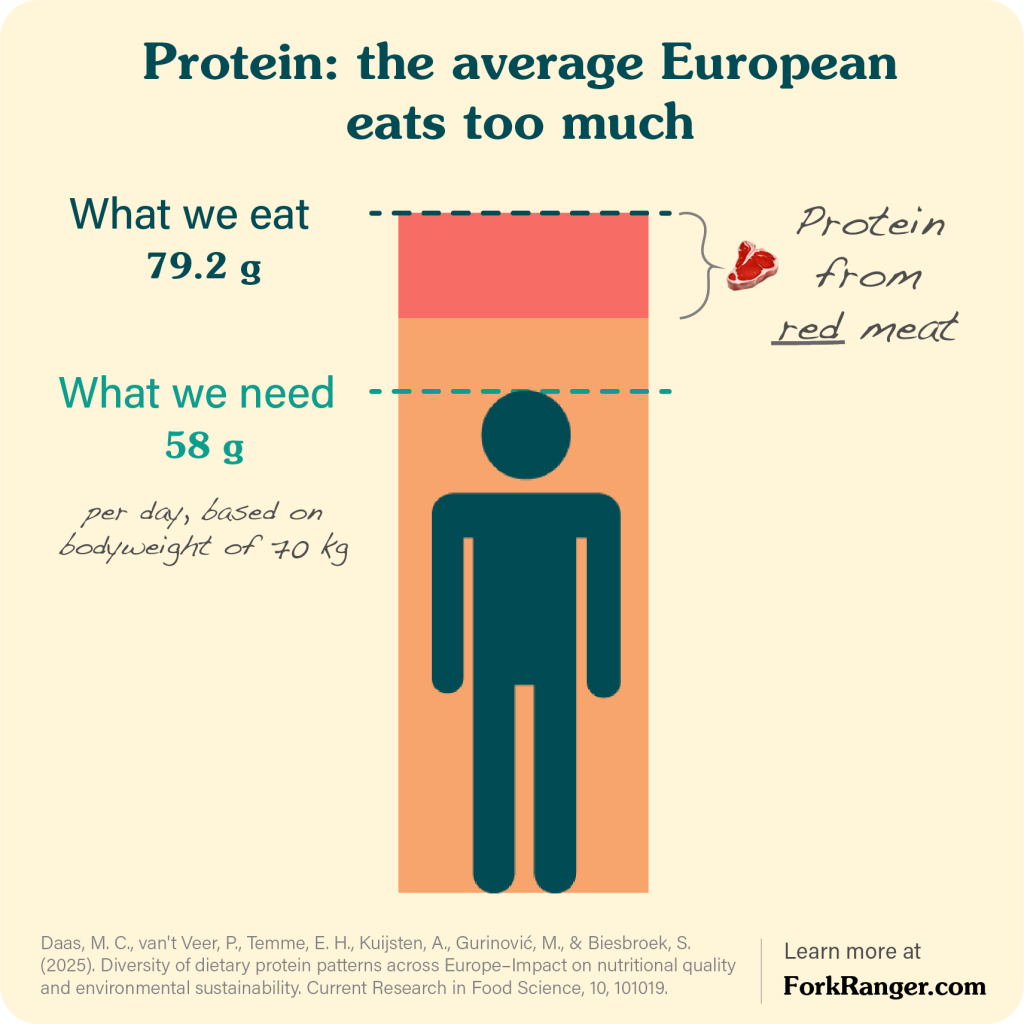
Research shows that on average we’re already eating more than enough protein. In Europe people eat on average 79.2 g of protein, while we only need 58 g on average. How much we need exactly is based on your body mass and slightly varies with your age. The European Food Safety Authority recommends to consume 0.83 g protein daily per kg body weight. There are no clear recommendations that take into account age, but some research suggest that we might even need to increase the recommended daily intake for older people. Let’s make it practical: when you weigh more than 95 kg you would actually need those 79.2 g of daily protein, but chances are you then also eat more than average, and therefore automatically eat more protein as well.
So, in general you don’t need to worry about eating enough protein-rich foods.
But I am working out… do I get enough protein?
Am I average? That’s a good question. As many people aspire a healthy lifestyle and are working out, don’t they need more?
The European Food Safety Authority (EFSA) concludes that this level of 0.83 g of protein per kg bodyweight is enough for virtually everyone (97.5% of healthy adults). Many people think it should be higher but the EFSA advises that the extra burnt calories simply require more food, not a focus on extra protein. So, people who exercise more than average, will eat more, and this results in a higher intake of protein per kg bodyweight for maximum muscle recovery and increasing muscle mass. This is simply the result of eating more normal food, not extra protein.
The only issue when you do a LOT of sports, like professional athletes, is that at some point you cannot eat and digest that much, so then special solutions like supplements come in. Also good to know: they didn’t find any extra benefit for either muscle mass or performance when increasing protein intake beyond this.
Sources of protein: meat, fish, dairy, eggs, grains, legumes
To understand how this changes when we eat less meat and dairy, we have to look at the source of all that protein. First of all, almost all foods contain protein. Still the first thing that comes to mind if you ask people about protein will be: meat. Meat gives our bodies protein, but it’s not our main source. Dairy & eggs and cereals together still make up the a bigger part.
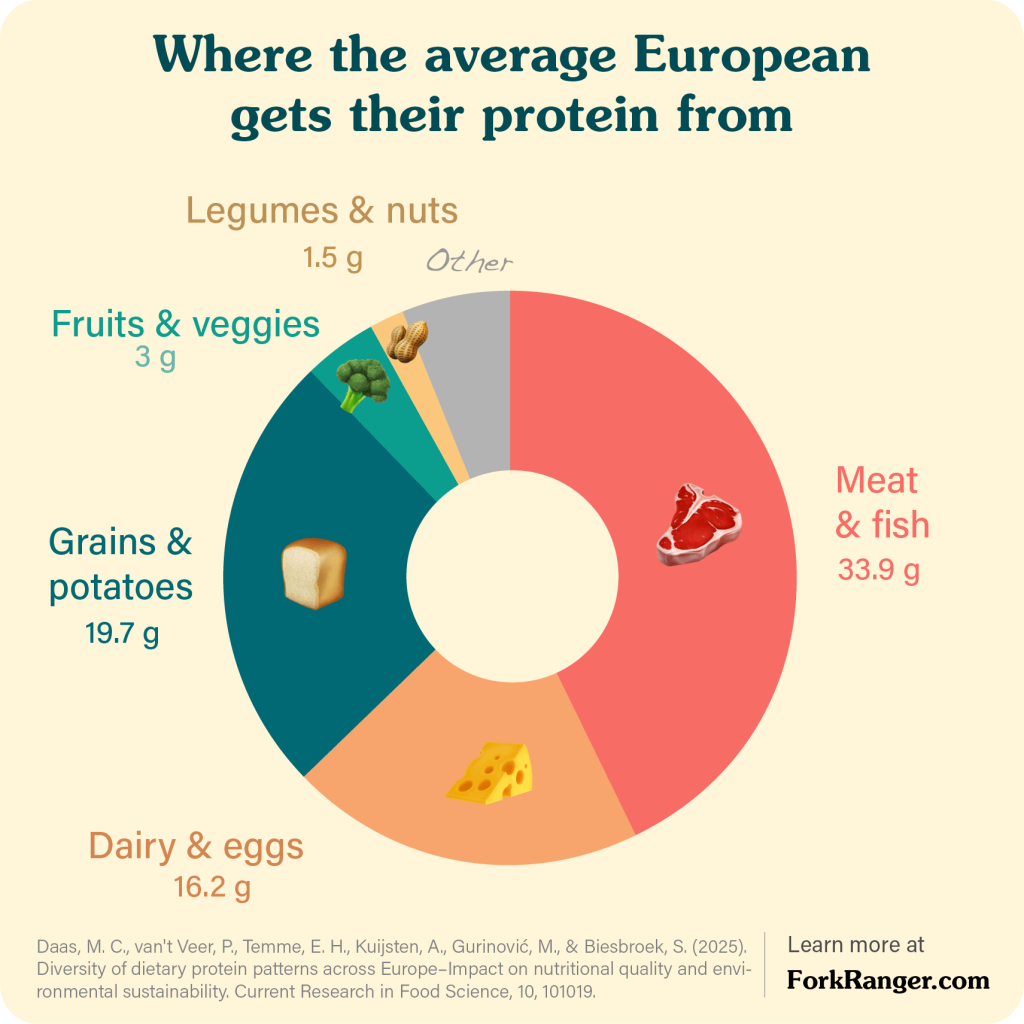
So if the average European would just leave out red meat (without replacing it) they would still get enough, as you can see in the previous infographic. In other words: you don’t have to find a meat replacement for every meal. Let me share what I eat on a typical day, to show you how I reach my needed protein.
Breakfast:
– 50 g of oats (6,5 g protein)
– 150 g of soy yoghurt (6,8 g protein)
– 15 g of sunflower seeds (4,2 g protein)
Lunch:
– 4 slices of bread (17,7 g protein)
– 1 slice with peanut butter (6,5 g protein)
– 3 slices with hummus (2,5 g protein)
– 1 tomato (0,7 g protein)
Dinner:
– 100 g of pasta (13 g protein)
– 50 g of peas (3 g protein)
– half a zucchini (1,2 g protein)
– 50 ml of soy cream (1,2 g protein)
– 100 g of spinach (1 g of protein)
Snack:
– 1 slice of bread with peanut butter (10,9 g protein)
Total: 75,2 g protein
The dinner quantities come from the Green Lemon Spaghetti recipe from the Fork Ranger book (page 118).
How proteins from plants and animals compare
Here it starts to get a bit technical, but I do want to share this as it comes up in some of the conversations.
“But meat contains complete proteins, plants don’t”
To unravel where this worry comes from, we have to dig a bit deeper. Luckily there is plenty of research about this.
So far we just looked at grams of protein and not what it’s made of. Protein consists of 20 types building blocks: amino acids. These 20 are categorized in essential ones and non-essential. Some are labelled non-essential because your body can make them from others. For the essential ones that isn’t the case. That’s why it’s essential that they’re in what you eat. Sounds simple.
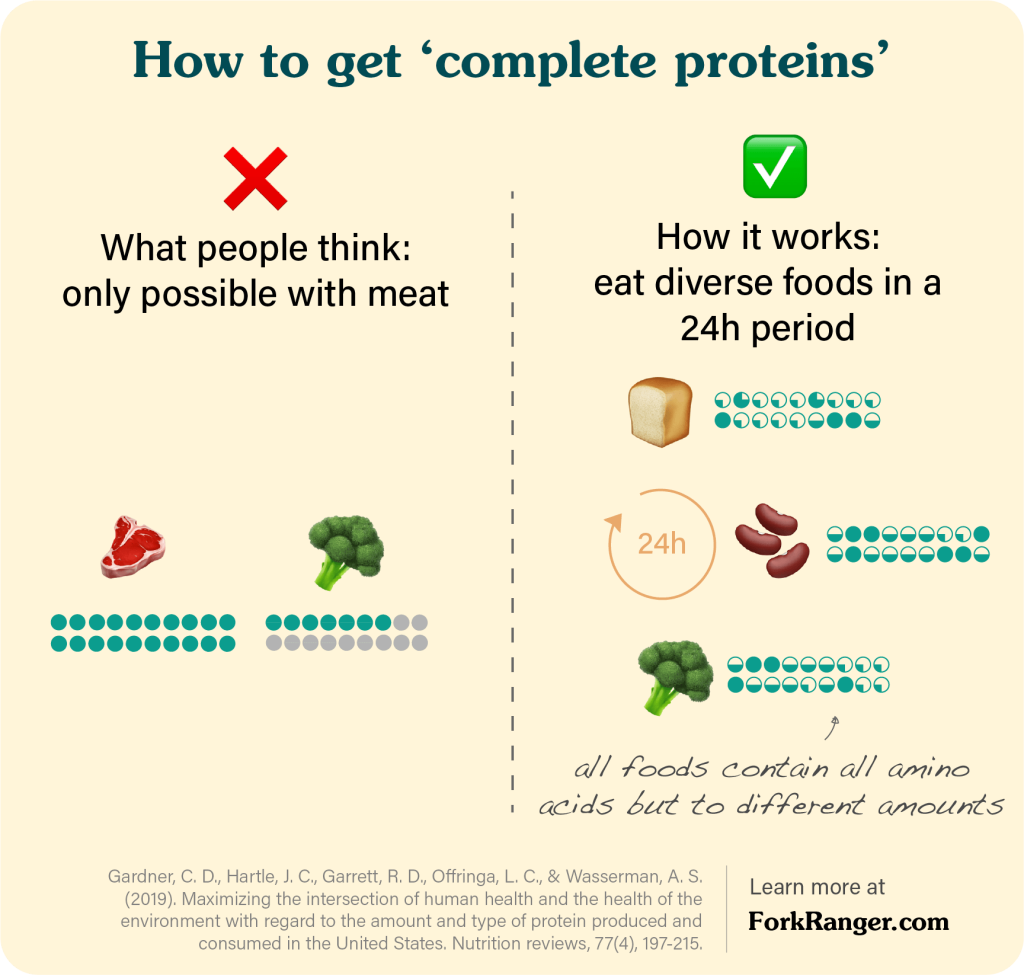
For each type of food the amounts of the essential and non-essential ones are slightly different. And also our body requires different amounts of each amino acid. What is meant by ‘meat is complete in proteins’ is that meat (and other animal products) contains a set and quantity of amino acids that is similar to what we need as humans. A single plant-based food has a different set and quantities, that’s less similar to what we need. However, eating a variety – like legumes and grains – complement each other well and are together also complete.
So no stress, as long as you don’t live on a peanut butter or hummus-only diet, there is really no need to worry about not getting ‘complete proteins’. So what’s the optimal way to get ‘complete proteins’ from mostly plants? It’s hard to give you a specific answer because there is limited scientific information about the digestion of differently combined plant protein sources and resulting absorption of amino acids. A lot of the research focuses on digestion of a single protein source or isolate, but a meal is of couse combination of many protein sources. And this affects the results.
Other research states that there is no evidence yet that it’s important to combine different plant proteins in the same meal, and it appears that a variety of protein sources over the period of a day is appropriate.
Conclusion about protein
Let’s not panic about protein. In general, we already eat more than enough. And proteins from various plants are together as complete as proteins in animal products. The chance that you need to worry about protein is very very low, even if you consume no or little meat and/or dairy. It’s all about eating enough in general, eating a variety of plants including some protein-rich plants.
The only exceptions are people who are not consuming enough food overall or avoid consuming protein-rich plant sources like legumes, nuts and seeds or protein-rich meat/dairy alternatives. Or people who are living on a very limited and monotous protein source, for example if they’re only eating grains. However, the latter is an almost unrealistic scenario, so chances are big you don’t fall into any of these categories and your consumption pattern regarding protein is just fine: there is really no need to worry about your protein intake.
For the Fork Ranger recipes we’ve always included at least one protein-rich source, and very often there are multiple sources that contain plenty of protein and complement one another. [We’re at the moment working on making nutritional information available for our recipes]
Looking for new inspiration? Most of the recipes in the Fork Ranger book and seasonal calendar contain multiple sources of protein.
Note: always consult your GP. This article is in no way giving you any medical recommendations or asking you to override your doctor’s advice. Fork Ranger is not responsible for any health issues you may have or develop in future.
De eiwit inname is erg onder discussie. Er zijn verschillende kampen. 1 ding is zeker, een te laag eiwit-inname resulteert in afbraak spiermassa. Vooral ouderen hebben vaak een te lage inname. Bij ouderen en chronisch zieken is een eiwit-inname advies van minimaal 1,5 gr per kg lichaamsgewicht. Voor gezonde volwassenen zou 1 gr per kg lichaamsgewicht voldoende moeten zijn, mits zij niet (intensief) sporten. Noten en vlees t.ov. elkaar vergelijken is ongeveer 1:2 wat betreft eiwitgehalte. Qua kcal is het 2 (of meer) :1. Dat kan ook een reden zijn om er naar te kijken.
Obesitas is en groot probleem! Vaak gepaard gaand met en (zeer) ongezond eetpatroon.
Deze mensen moeten echt met een diëtist gaan praten vóórdat zij, welk voedingspatroon gaan omarmen. Tekorten zijn nl al vaak opgebouwd door het ongezonde eetpatroon.
Hi Brigitte, dankjewel voor het highlighten van ouderen. We hebben dit kort ook genoemd in de 2e alinea. Noten bevatten inderdaad meer kcal voor dezelfde hoeveelheid eiwit, maar dit is niet gelinkt aan obesitas (een van de artikelen die je wellicht interessant vindt: https://www.sciencedirect.com/science/article/pii/S2161831322001764). Dankjewel voor je reactie!
Hi, I just found your site and have downloaded the app. I’m excited to find a Euroean based source of info on sustainable eating that seems to be sensible and science backed.
I’m considering ordering your seasonal calendar because it looks so lovely but wanted to check on something first.
I noticed that your site says that the info on seasonailty for fruit and veg is relevant only to UK, Netherlands, Belgium and Germany. I live in Ireland which is very similar the UK in terms of seasonal weather and variation, so wondered if the info might still be relevant for my area as well?
Also, I notice that the map image on the seasonal calendar listing has an inconsistency. The boundary line between Northern Ireland (UK) and the Republic of Ireland on the map is correct but Ireland’s county Donegal is filled in as green even though it is not part of the UK.
Thanks in advance for taking the time to read this, and if you are able to respond to my question I’d be most appreciative.
All the best,
Lisa
Hi Lisa, thanks for your message! Regarding your question about Ireland. We haven’t double checked all sources for Ireland, but EUFIC (https://www.eufic.org/en/explore-seasonal-fruit-and-vegetables-in-europe) does place Ireland and the UK in the same climate region. This suggests that as the climate is quite similar, the seasonal fruit & vegetables will also be quite similar.
And thank you for pointing out the issue regarding the boundary line. We will fix this.
May the forks be with you, Mareike