How you can eat together sustainably, even if your partner is less interested
Main learning: you don’t have to be on the same page with your partner to still make an impact together
Goal: be pragmatic, find out what works best for you
Impact: Very High 🌍🌍🌍🌍⚪️ as part of inviting more people to take steps to eat sustainably (see full Compass)
For me, this was a bit easier when I (vegetarian) met my partner (meat lover), because we knew from the start that we had different food preferences. But we still had to figure out how to approach this together. So I can easily imagine this being a big challenge if you’ve been together for a while, live together, or are friends, and still want to take steps in eating more sustainable!
Eating together not only feels good, research has also shown that eating together is actually good for us. People who eat with others feel better about themselves and have a larger network that can offer social and emotional support. You also feel more connected to those you eat with, and even more so when you laugh and reminisce over dinner. So, of course, you don’t want to jeopardize all these good things because of your preferences.
Perhaps that’s why eating something different is so difficult; it’s often not an individual choice at all. It has a huge social impact, and that’s precisely what’s so important! Sharing a meal with others is valuable, and that’s simply more difficult when you want to eat something different than the other person. So what’s the best way to approach this? Because cooking twice is obviously a bit pointless.
By the way, you’re not alone. When we asked people in a Fork Ranger survey to indicate what their partner (or housemate) thought about eating sustainably, almost half of the people said they had a partner who was less interested or motivated. So, it’s high time to look for solutions.
Scenario 1: you want to eat less or different meat
If you don’t want to eat meat or fish at all, scroll down to scenario 2.
Even without becoming vegetarian or vegan, you can eat more sustainably. Simply by choosing less or different meat. Meat, especially beef, is one of the ingredients with the highest climate impact. This is because 1) animals require a lot of feed and therefore land, and 2) because ruminants (like cows) burp and fart, which release methane—an even stronger greenhouse gas than CO2. So, if you eat less or different meat, you’re already making a big impact!
But what do you do if you want to eat less or different meat, but others around you don’t think so? Let’s focus on those you live with and often cook and eat with. Below, we share three different ways you can approach this. If you don’t want to eat meat or fish at all, scroll down to scenario 2.
We calculated how sustainable each approach is based on Ekomenu‘s recipes. They’re one of the few companies which publish the CO2 impact of their recipes online, and we were very happy when they shared the details with us! We chose Ekomenu recipes also because they offer a wide variety of recipes. For example, also options with meat and fish (which we don’t have ourselves).
How did we determine whether the approach is sustainable? Ekomenu explains here that a sustainable evening meal has a CO2 impact of 930 grams. Fork Ranger also looked into this and arrived at a sustainable target of 946g CO2 based on other studies (WNF and RIVM). To be on the safe side, we’ll in this blog use the lowest value of 930g CO2 as the sustainable goal for our evening meal.
Approach 1) you both choose recipes for half of the week
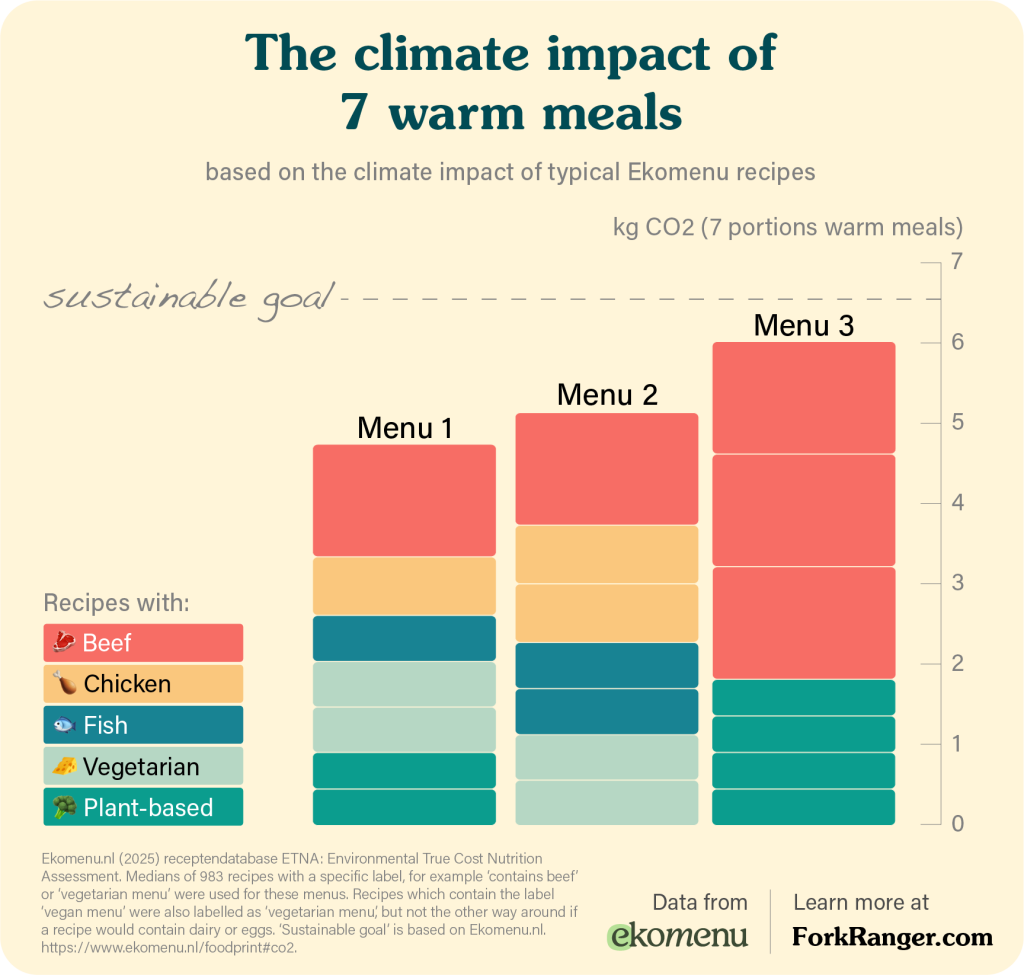
Perhaps this approach is the most obvious: you both choose half of the meals. After all, you share a household, so it would make sense for both of you to have an equal say in what ultimately ends up on the table. Of course, you’ll be mindful if the other doesn’t like mushrooms, but even then, there’s still plenty of choice. Suppose you choose two vegetarian and two plant-based dishes, and your partner chooses one with fish, one with chicken, and one with beef (menu 1). On average, you’ll still end up with a sustainable diet. This demonstrates once again that, in terms of climate impact, you don’t have to become vegetarian or vegan to eat sustainably.
Even if you both choose meat a little more often, but meat with a lower climate impact, such as chicken and fish, you’ll still achieve a sustainable outcome (menu 2). But what if your partner is a beef lover? Imagine your partner chooses three meals with beef. You could choose four fully plant-based meals, and surprisingly you’ll still be below a sustainable level for CO2 impact (menu 3). This wouldn’t be the case with just any recipe with beef out there on the internet, but is due to the special attention in Ekomenu’s recipes. You’ll discover why below.
Is it really necessary to split this so 50/50? To find this answer, I made a hundred Ekomenu recipe selections for a year: completely random. Sometimes there were duplicate recipes, but otherwise, each selection was different throughout the year. And guess what?
In three-quarters of those one hundred simulations, the resulting dieet was still at a sustainable level. That is, the CO2 impact of the average recipe was lower than 930g CO2 per serving, our sustainable goal. And even in the other quarter of cases where the goal was not met, the CO2 impact was still much lower than the Dutch average.
I was quite surprised by this outcome, so I went through the data. And it turns out: this is because Ekomenu already offers a relatively large number of recipes with a low climate impact. In addition, they use small portions of meat: better for the climate and your health!
If you were to do the same for all the recipes from, for example, a supermarket chain, you would probably end up with a higher figure, because the ratios between recipes are different (more recipes with meat) and the amount of meat per portion is often higher.
Approach 2) add some cheat days every now and then
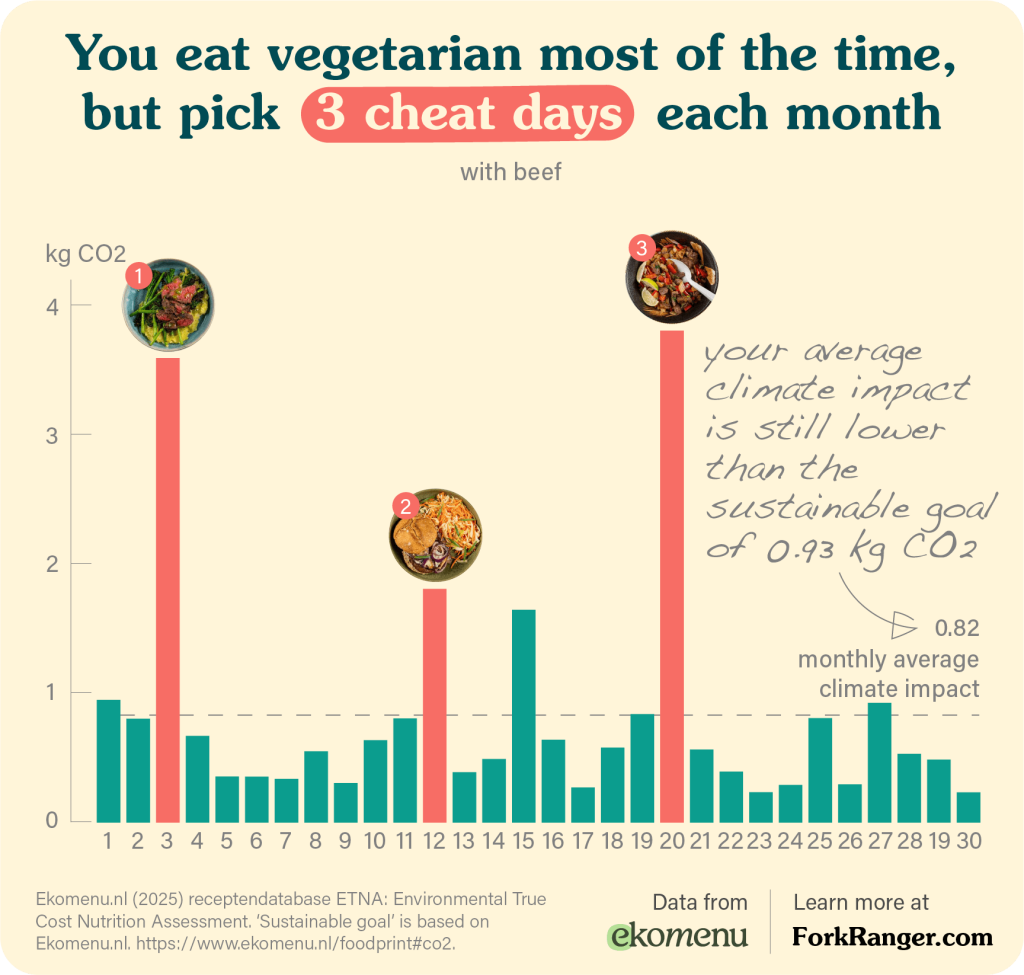
You now choose a general approach together, which you use most of the time, but sometimes you deviate from it, the so-called cheat days. Quite often your partner is willing to adapt to your wishes, but not ALWAYS. Don’t expect your partner to make the same choices as you. And fortunately, you don’t have to. Allowing cheat days can also make things much easier for yourself. It’s easier to eat sustainably if you don’t feel like you can never eat something again. And there are often times when you both can make different choices: when you’re dining with friends, at a dinner for work, or when you’re eating out together. Even at home on the couch, you can sometimes decide to schedule a cheat day together. This gives you a little more freedom which will in the end actually help you achieve your goals.
Suppose you choose to eat mainly vegetarian at home, you can still choose a meal with a higher climate impact 3 days per month (for example the Ekomenu recipe Steak with chimichurri bimi and parsnip puree (1), Hamburger in a bun with ‘coleslaw’ and tarragon sauce (2), and Wok with beef strips, pak choi paprika and lime rice (3)). And still you end up being on average sustainable! If you eat mainly completely plant-based, your average CO2 impact will be slightly lower most days, and you can even include 4 days as a cheat day. That’s already 1 evening a week ;).
Approach 3) focus on the climate impact and not on whether something is vegetarian or plant-based
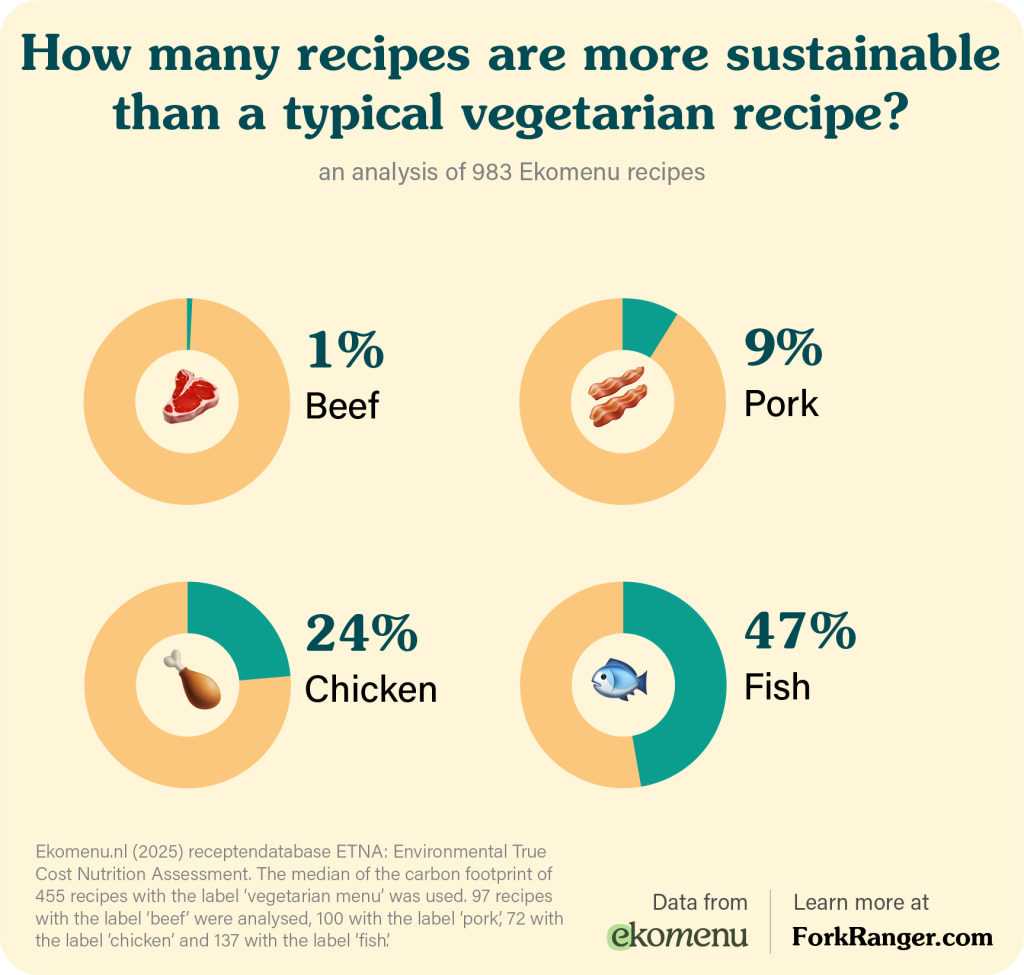
This method can help you break the black-and-white thinking of “eating meat isn’t sustainable” and “vegetarian is sustainable”. Perhaps the other methods give you the impression that vegetarian meals always score better in terms of climate impact. And this is often true, but not always.
The good news is that if your partner is a meat lover, you can find a meal for every type of meat with the same climate impact as a typical vegetarian meal. However, this is more difficult for some types of meat than others. For beef, for example, among all the Ekomenu recipes with beef, there’s only one recipe where this is the case. There are a few more meals with pork and chicken that have a similar impact to a typical vegetarian meal. Meals with fish actually have a comparable climate impact. That’s why there percentage is close to 50: they score better about half the time and worse about half the time than the typical vegetarian dish.
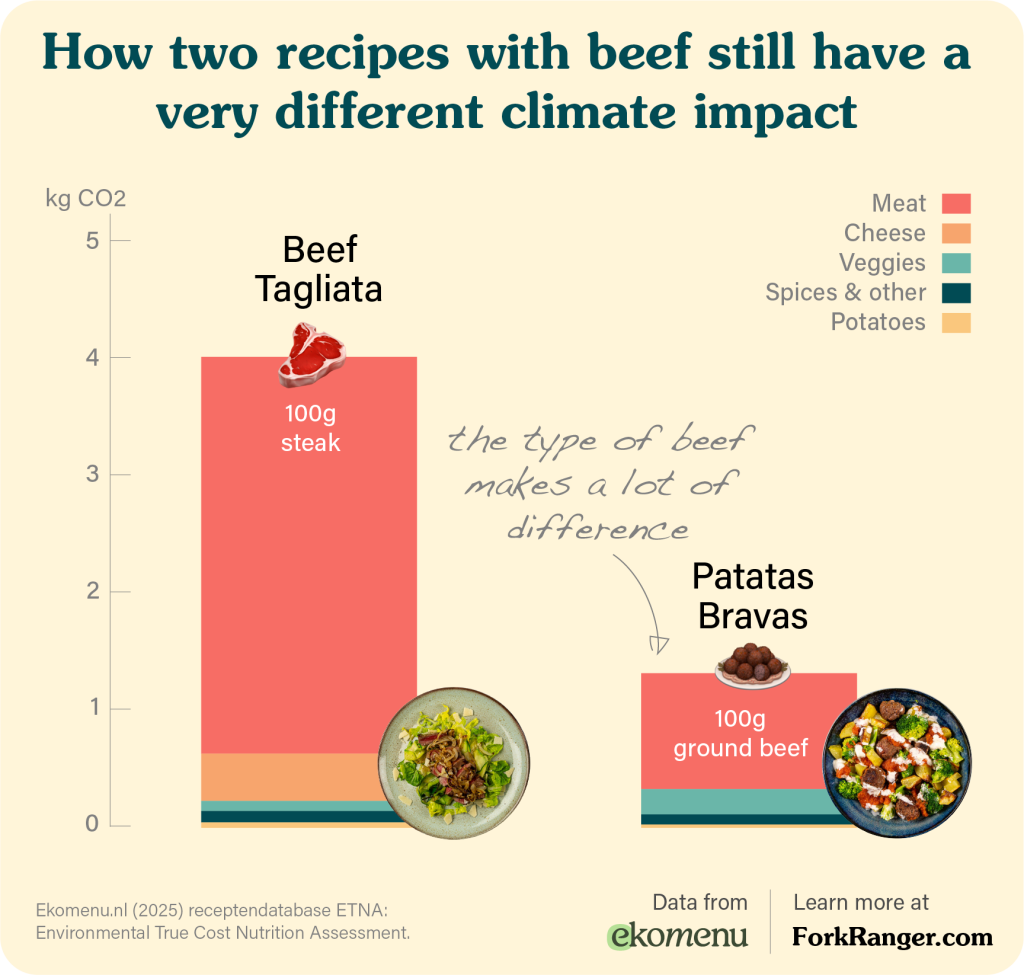
To illustrate even more clearly how many recipes can differ from each other, we examined two beef recipes in detail. For example, if you look at the Steak Tagliata with Parmesan (not to be confused with tagliatelle) and the Patatas Bravas with Aioli with Meatballs in Tomato Sauce, you’ll see that both contain 100g of beef per servings. Yet, the climate impact of the first recipe is 2,5 times higher than the second. This is due to the type of beef used. The climate impact of a steak is much higher than that of beef sausage, because steak is primarily made from cows that are specifically kept for beef. This means climate emissions can’t be further divided between milk and dairy products, as is the case for sausages made from dairy cows. These kinds of small details can therefore result in a significant difference in the climate impact of even a particular category of recipes.
If this approach appeals to you, you can look at the Ekomenu recipes together and choose recipes with a low carbon impact. Each recipe includes a “measure how well you eat” tag. Look for the following icon:

If a recipe has a 45% CO2 reduction or even lower reduction, you know it’s sustainable.
Unfortunately, this approach is a bit trickier if recipe data isn’t available. The Fork Ranger app is also a good choice, as almost all recipes are without meat and contain less dairy. We did this because people often already have a few favorite meat-based recipes and are primarily looking for new vegetarian or plant-based recipes. However, the Fork Ranger app might not be the best platform for this approach, as your partner might be less happy if there are no meat options shown.
Scenario 2: you don’t want to eat meat or fish at all
It’s also possible that you’d rather not eat meat or fish at all (and perhaps also no dairy or eggs either), but your partner, roommate, or friends do. In that case, it’s naturally a bit more difficult to find a solution, because the approaches mentioned above aren’t suitable.
Here are a few tips that can help:
- Offer to choose recipes, do the grocery shopping, and cook: it’s especially challenging when you want to eat together. You want to eat vegetarian or plant-based, but the other person, who doesn’t necessarily want that, is under pressure to put a good meal on the table. Finding new ingredients in the supermarket, getting used to new ingredients in the kitchen, and simply learning to cook differently are all hurdles that are extra difficult for your partner to overcome, especially if they’re not the most motivated. So by taking more responsibility for this (initially), it’s easier to introduce them to it.
- Let them order meat separately/add it to a complete meal. This might sound obvious, but it’s important not to do it the other way around (e.g., picking meals based on meat and leaving out the meat), because then you’ll miss out on nutrients. Your partner could, for example:
- Add chicken to curries or wraps
- Add pork sausages to potato dishes
- Add bacon to pasta
- Cheese is easy to add or leave away in many dishes, because it’s often added at the end. In a casserole, you can choose to sprinkle some on only a part of it (and use a plant-based substitute for the other part). I often do this myself now that my partner has switched from a meat lover to eating a full plant-based diet, while I’m a vegetarian.
Conclusion
Eating more sustainably while your partner, roommate, or friends aren’t as enthusiastic can be quite a challenge. Fortunately, there are several pragmatic ways to help you take steps and still eat together: because eating together is good for you! So you definitely shouldn’t miss out on that ;).
If you still eat meat/fish, but less or with a lower impact, you could choose to both decide what’s on the table half the week. In most cases, you’ll still end up with a sustainable diet together. Good to know, if you choose randomly from Ekomenu‘s recipes, you’ll be fine in three-quarters of the cases.
Another way is to see if you can adopt a certain basic approach and allow yourselves a few cheat days every now and then. This way, you create mental space: there’s nothing you can never eat again.
And finally, you can also consider the climate impact of a dish. This helps you avoid getting bogged down in the “vegetarian” and “plant-based” labels, because you can find a recipe for every type of meat (beef, pork, chicken, fish) that also has a low climate impact. Although I must say, there are far more options for chicken and fish than for beef.
If you don’t eat meat or fish yourself, the challenge is greater, but not impossible. For example, you can choose a larger portion of the recipes, shop for groceries, and do the cooking (as this might be difficult for your partner with vegetarian or plant-based dishes). You can also flexibly serve meat, fish, or cheese on the side, so there’s something for everyone.
And even if you find all this a bit of a hassle, generally speaking, you’re in good hands with Ekomenu, the source of the recipe data for this blog. They already have many climate-friendly recipes, because they’ve used sustainable quantities for meat and fish recipes as well. And that’s not even mentioning the fact that you’re automatically eating organic, thus contributing to more organic farming!
This blog was created in collaboration with Ekomenu. They’ve shared their data so we could create and share these insights with you. We don’t get anything else if you click the links here, we’re simply happy to recommend them (because we have the same mission). The infographics are made by Marta from Why This?
Goed artikel. De data geven een mooi inzicht in de relativiteit van e.e.a.!