Central in the Netherlands micro food adventure 🥾
This micro food adventure is part of a series of microadventures to discover sustainable food pioneers. Read more about our the impact of local food and don’t forget to let us know how you experienced this route (mareike@forkranger.com).
Link to the normal route – 13,5 km
Link to the longer route – 18,3 km (you see a bit more forest: Beerschoten, Houdringe and Panbos)
Tip: if you use komoot app without the navigation function, it’s free!
This route leads you through Utrecht’s ‘backyard’. To spend as much time as possible in nature, we start from station Bunnik. It’s designed as a hiking route 🥾 involving as many footpaths as possible, so don’t try to do it by bike.
First stop: Amelis’Hof
From there we make our way to the Kromme Rijn and follow it to Amelis’Hof, our first stop after 3,5 km.
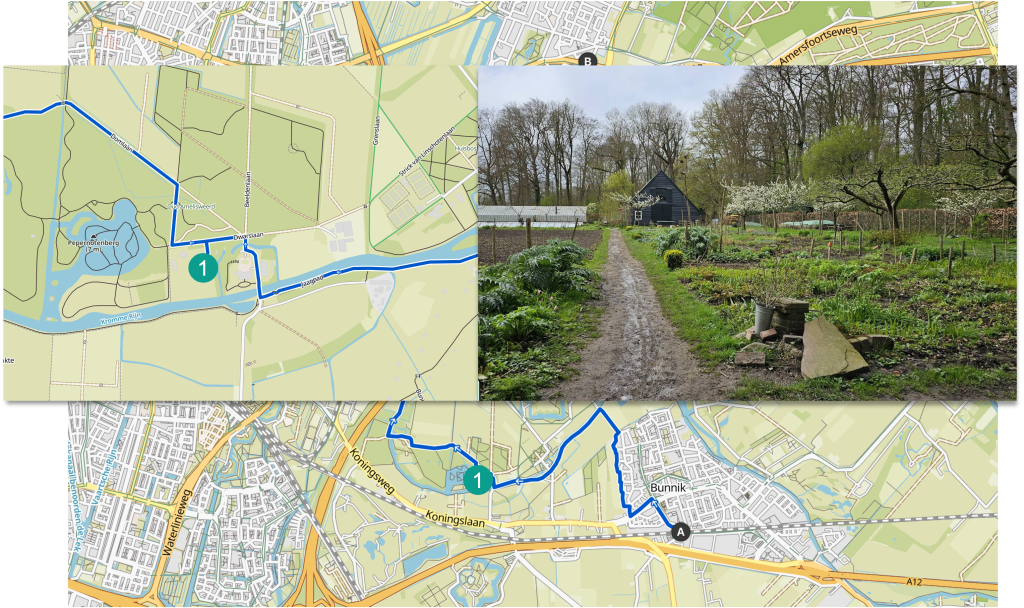
Why we picked this stop for you → At Fork Ranger we often talk about the importance of increasing organic food production. This vegetable and flower garden practices a special form of growing food organically: biodynamic agriculture. The difference is not something that might be directly visible from the outside, but lies in a different approach that goes beyond the organic practices. Actually, biodynamic agriculture was the first form of organic agriculture when philosopher Steiner proposed it in 1924. Rather than different farming practices, it originates from a different vision of life. This is also reflected in the 5 core values of Demeter (the international biodynamic certification):
- Caring for a living soil
- Respecting the integrity of the animal
- Caring for life forces
- Viewing the company in context and the care of the business organization
- As a human being wanting to develop in agriculture
This might sound a bit up in the air, but keep in mind that this thinking came from the one who stood up against industrial farming and was the founder of an alternative from which the whole organic movement stems. Or wait, wasn’t organic the standard before we started applying synthetic fertilizers and pesticides? Maybe if you spend a bit more time in the garden and contemplate this, you’ll feel the difference. In the gardeners words:
“Stroll around, stroll along the wide grassy paths, peer into the toad pool behind the barn or sit on a bench by the water and contemplate. There is always a cup of herbal tea ready for customers. In season, of course, made from fresh herbs from our own garden. Feel welcome to simply be.”
On Wednesdays and Saturdays in the spring and summer (see extra info below) you can also buy some vegetables and find out later if they taste differently to you.
Second stop: De Moestuin
After you’ve enjoyed this garden’s energy it’s time to hike further to our second stop De Moestuin. You reach it after 6,9 km from the start, so you have made it half-way. It can be a bit hidden, but right when the parking lot is at your left side, you turn left onto the parking lot and around the corner you find the entrance (see below). You can also have a lunchbreak in their restaurant.
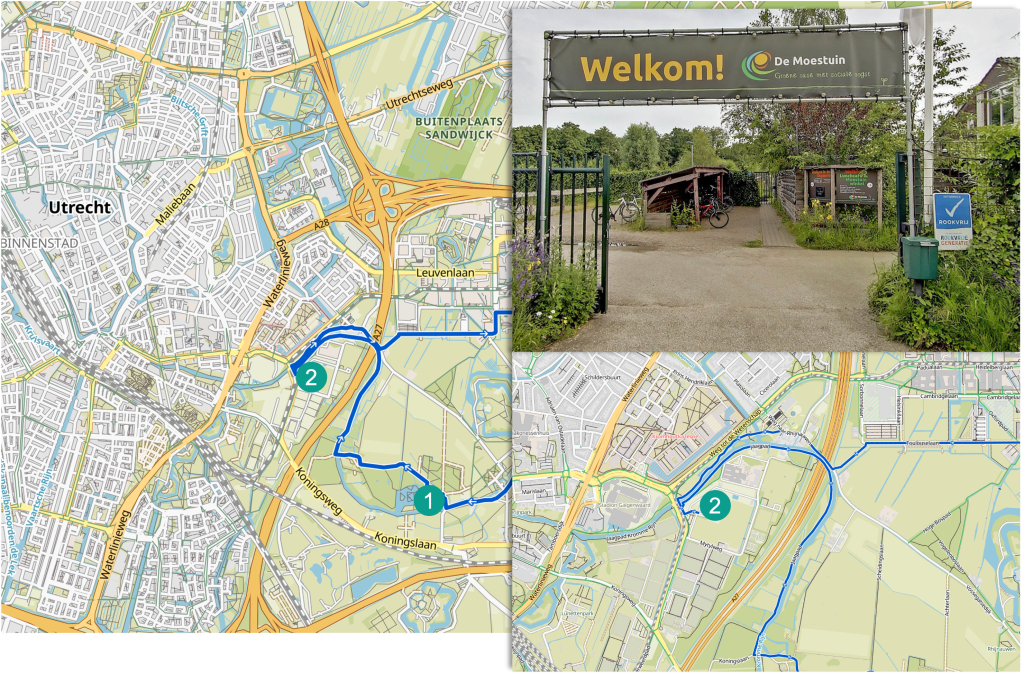
Why we picked this stop for you → In our current food system the way from production all the way to the food on our plate is often a long one, involving many steps we can’t see. By the way, this is also what can make it hard to understand the climate impact of our food. It simply happens at places where we cannot see the scale of it. At De Moestuin it’s the opposite – the supply chain is fully transparent and it’s short. We like how they have thought about how their concrete actions and set-up works with the bigger goals they want to achieve. On their webpage they have a nice graph showing this. For example, they’ve tied the fact that visitors can walk through the vegetable garden and can see (and read about) how the vegetables grow to the goal of increasing awareness and understanding of sustainable and healthy food choices. So, make sure you walk through the vegetable garden and if you want, enjoy some of it on your plate during lunchtime.
Third stop: Fruitbedrijf Westeneng
Passing by the Campus of University of Utrecht (if you like Botanical Gardens, there’s one, make sure you add it to your route – entry fee applies), we make our way to Fruitbedrijf Westeneng. You reach it almost 11km from the start.
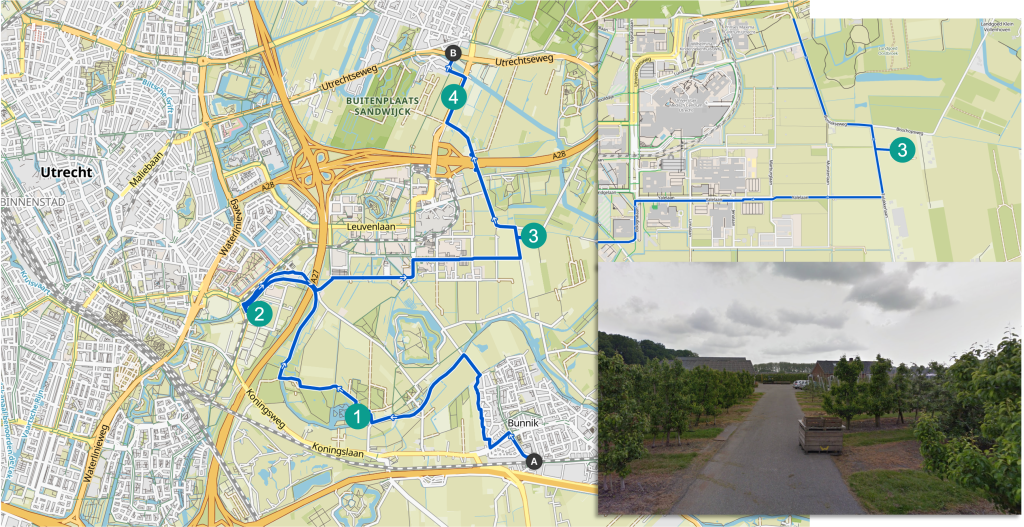
Why we picked this stop for you → If you are into how farms work, you might have seen this location in a Onze Boerderij episode (from 10:10). Izaak explains how the risk of night frost after the fruit trees are already flowering leads to imperfections in the fruit. Pears can have long banana-like shapes and apples can get some marks. While this doesn’t affect the taste, all of a sudden the affected fruit becomes worthless in the ‘normal’ supply chain. In Europe, around 30% of all fruit is discarded because of cosmetic imperfections (due to night frost and other causes).
Local farm shops can be a great solution to this. Here there’s no one that determines whether this apple has a Class 1, Class 2 or other appearance, it’s all up to you, the consumer. It’s all in the eye of the beholder. Have a look at their farm shop: can you see the imperfect fruit (if there happen to be some) you can buy here as something beautiful, something directly leading to less food being wasted? I bet they taste twice as good now you know that eating imperfect fruit is one of the main climate food solutions!
Fourth stop: Nieuw-Bureveld
We continue further north towards Herenboerderij Nieuw-Bureveld. The farm lies on both sides of the N412, between the vegetable garden association Het Kloosterpark and horse stables Fortunahoeve on the other side.
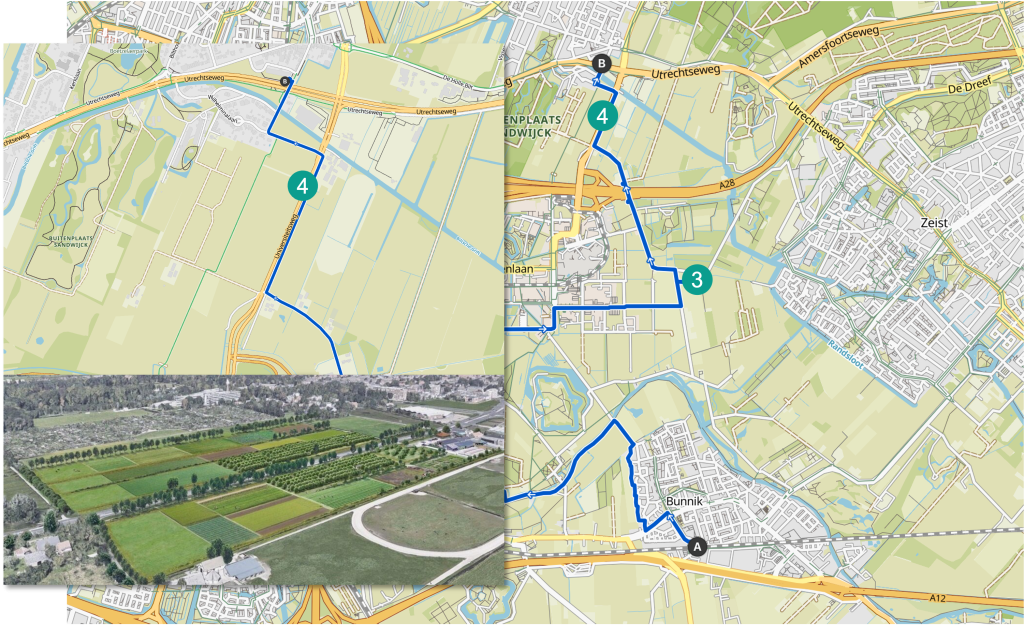
Why we picked this stop for you → This is one of the 22 Herenboeren farms in the Netherlands. While you also commit to a share of the harvest, it’s more than just that. The unique thing about a Herenboeren farm is: you own 1/250th of the farm. Together with 250 other households a farmer is hired who brings in the agricultural knowledge. This commitment enables also a stable economic foundation. And there is more to it… What is special about this location, is that it shows change is possible! Before Herenboeren started their farm here, farmer Dirk-Jan Stelling who owns the plot and nearby Landwinkel, had 80 cows. Because he now leases a part of his land to Herenboeren, he could shrink his number of cows to 50. It wasn’t an easy transition, but they did it! Now that’s something we want to see more of! It’s not about eliminating all meat and dairy, but about restoring the balance: eating more plants and keep meat and dairy as luxury in a sustainable diet.
You are almost at the end of this micro food adventure. It’s just a very short stretch to the bus stop where busses take you back to Utrecht Centraal. If you feel like your legs can still do it, you can also enjoy a little more forest and walk towards De Bilt station 🚉.
Extra info
- Amelis’Hof: the vegetable farm/garden shop is open from 3rd of May 2025 onwards on Wednesdays 11.00-17.00 and Saturdays 10.00-15.00.
- De Moestuin: the vegetable garden, small shop and restaurant is open every day 10:00-17:00.
- Fruitbedrijf Westereng: during the season strawberries on Monday til Friday 12.00-17.30 and on Saturdays 8:00-17:00 more fruits and additional regional products.
Erg leuk initiatief. Probeer per auto de adressen te bereiken. Loop niet goed.
Hi Didi, dat klopt, het is namelijk ontworpen als een wandelroute! Sorry, als dat onduidelijk was. Hopelijk kan je op een later tijdstip nog eens te voet op pad.