Why we talk relatively little about fish
Main learning: fish has a similar CO2 impact as chicken, especially popular ones like tuna, salmon and shrimp
Goal: choose sustainable options like smaller fish, or even better mussels and seaweed
Impact: Medium 🌍🌍🌍⚪️⚪️ (see full Compass)
In the Netherlands, we have a concept called ‘Friday Fishday’. I am not sure if this rings a bell for you but it stems from old catholic traditions in which people skipped meat and ate fish instead. You can make a quick calculation: if you eat fish once a week and meat on the other days, it doesn’t add up to a lot of fish.
People eat relatively little fish in Europe and North America
In the Netherlands – our Fork Ranger homebase – we eat an average of only 15g of fish per day, compared to 87g of meat per day. Compared to other European countries the Netherlands is about in the middle (although they report a higher daily amount for the Netherlands). Generally people in North America and Europe eat way more meat than fish, with the exception of Norway, Spain, and Portugal.
In the EAT-Lancet study a group of scientists investigated how we can feed 10 billion people in a sustainable and healthy way. They arrived at a sustainable amount of 28g of fish per day. That is about 1.5 fish fillets per week and it’s higher than the average Dutch amount. That is why in the Fork Ranger app, we give it less attention than meat, which exceeds the recommendation by a lot.
Fish has a smaller climate impact than meat
So, should we eat more fish? Let’s look at the climate impact of fish and other issues such as overfishing.
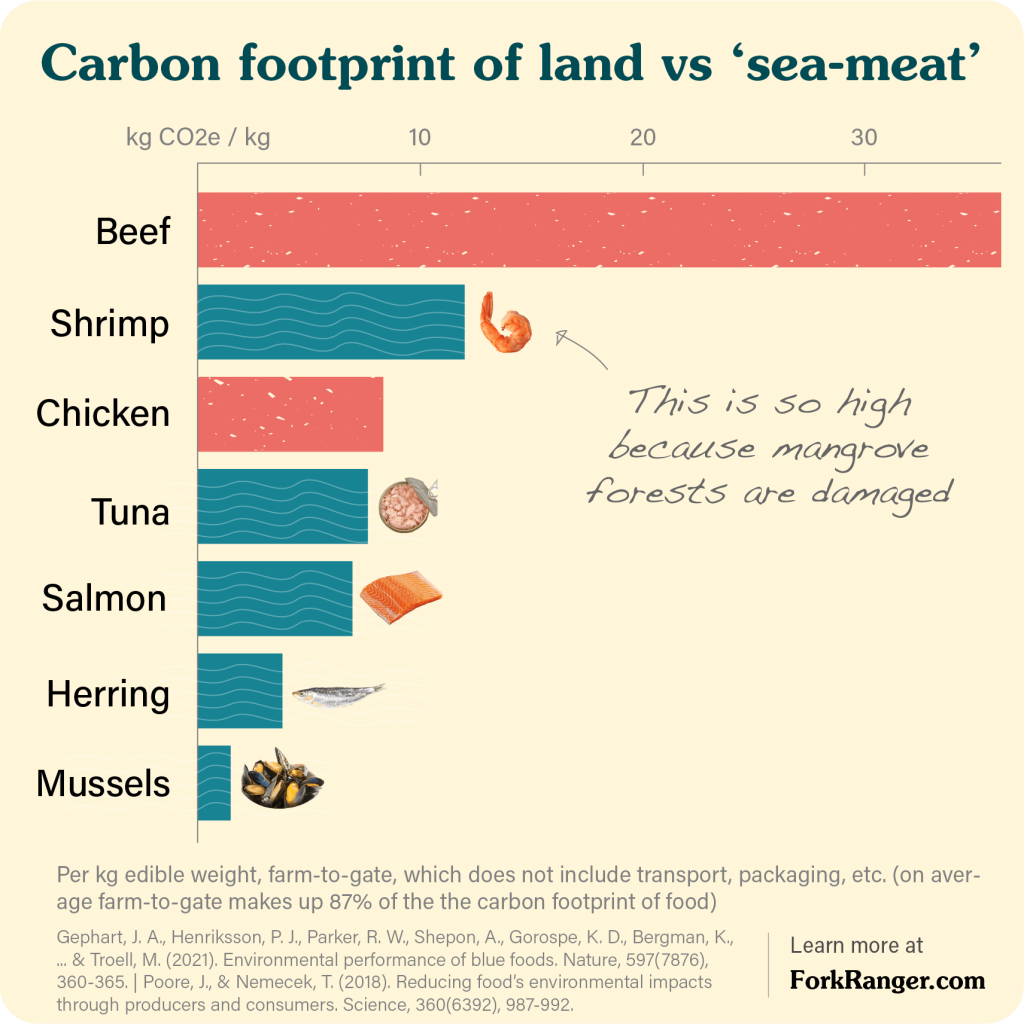
Just like with meat, there are big differences in the climate impact of different different fish products. But still, the fish with the highest climate impact has a smaller impact than beef. Also, most types of fish have a smaller impact than chicken. Bivalves such as mussels and seaweed have the lowest climate impact of all our food from the sea.
Why the type of fish matters
You may be wondering: “Can I eat salmon and tuna without climate guilt? The impact is comparable to chicken, right?”
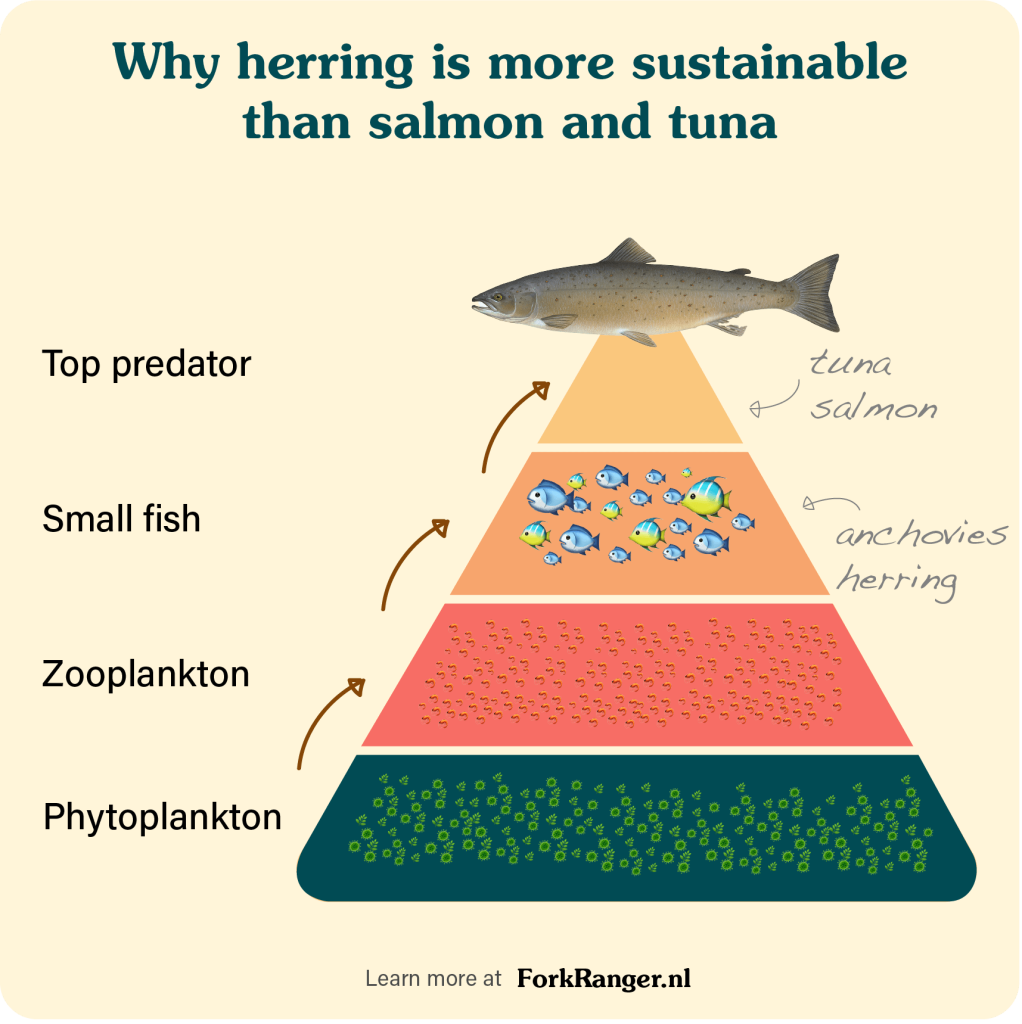
You wouldn’t be alone in this question, because salmon and tuna are the most popular fish to eat in the European Union. Most small fish lower down the food chain are caught to feed larger fish that we farm, such as salmon. We only eat 10 to 20% of small fish directly.
But if you use 1 kg of smaller fish like anchovies and herring as fish food, you cannot ‘produce’ 1 kg of tuna or salmon. So if you eat tuna and salmon, you indirectly eat many more kg of smaller fish. That is why it is more sustainable to eat the smaller fish directly if you keep the total amount of fish you eat the same.
An additional ‘problem’ with the larger fish like tuna and salmon is that they are at the top of the food chain. So they have an important role, but they are also extra vulnerable. If these top predators are overfished, the entire ecosystem can become unbalanced.
Is farmed fish a good alternative to wild fish?
In recent years, almost all of the increase in global fish consumption has been supplied by farmed fish. Almost half of all fish is now farmed. In fact, the same thing happened as with meat: when it became too much effort to hunt, we switched to farming. Farming fish avoids the problem of overfishing, but is it sustainable?
If you only look at the carbon footprint, wild fish often have higher emissions than its farmed counterparts. With wild fish, the emissions are higher because a lot of fuel is needed to get to sea. With farmed fish, almost no fuel is needed to catch, but the feed is the largest share of the emissions. How does that work exactly?
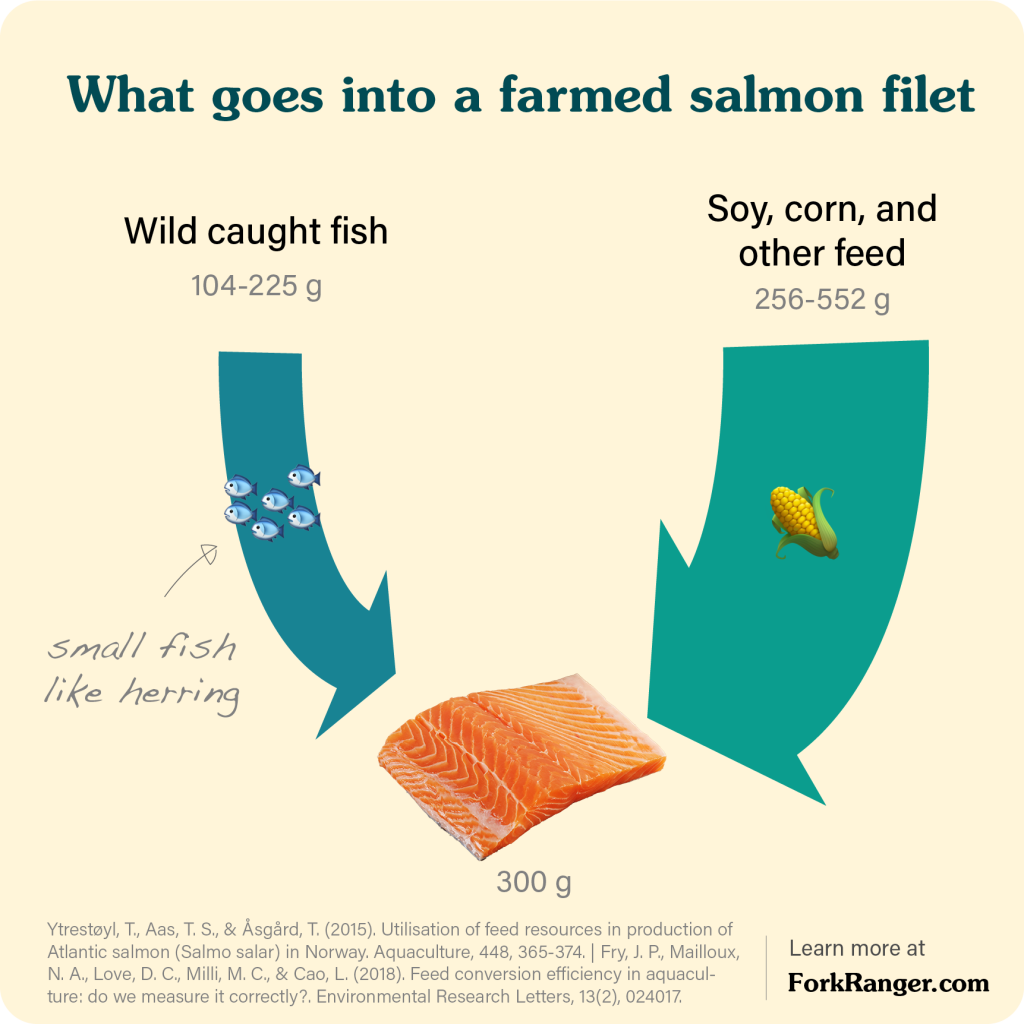
Farmed fish requires more than just a net in the sea. Farmed fish need to be fed just like other farm animals. For example, let’s look at a farmed salmon fillet. We feed the salmon partly with wild-caught fish. Besides the emissions of catching the feed, this can indirectly still lead to overfishing. In addition, farmed salmon also receives soy, corn, and other plant-based feed and this also requires land. So, just like with meat, more feed – which we could have eaten directly – is ultimately needed to farm 1 salmon fillet. This means that we need even more land for our food.
And because we farm so much fish in a small area, diseases can develop more easily. The fish is then treated with antibiotics and other chemicals. But this does not stop at the net and ‘leaks’ into the ocean. That is why some companies even want to start farming fish on a large scale on land.
The Ocean’s best for the climate: seaweed and mussels
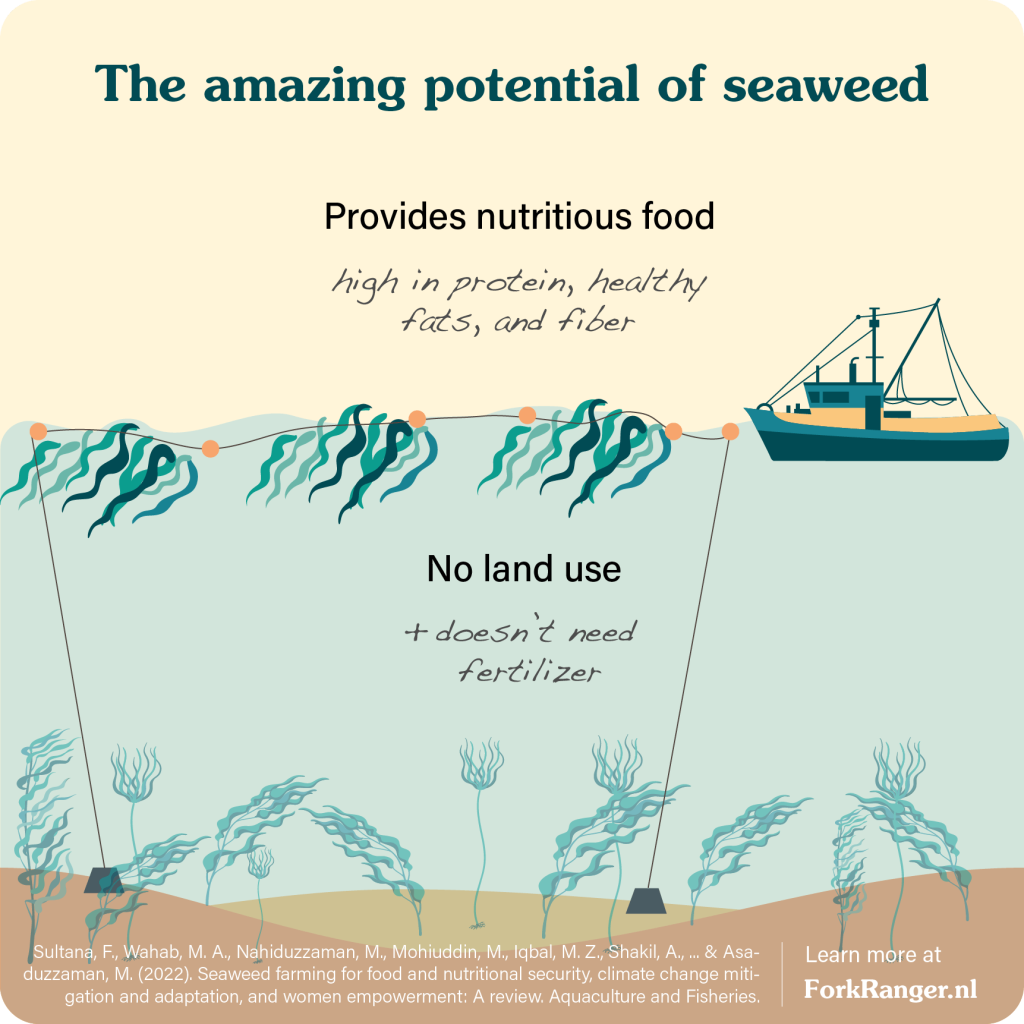
No matter how much we optimize fish production, nothing can beat the low impact of seaweed and mussels. Mussels have the added benefit of purifying water. And seaweed is a fantastic vegetable that doesn’t require land or fertilizer to grow.
Conclusion
So we don’t talk much about fish at Fork Ranger because we already eat relatively little fish (in the Netherlands), and we don’t necessarily need to eat more of it. There are still good reasons to keep our consumption stable, even if we are below the sustainable ‘limit’. While farmed fish seemed to be an answer to some major problems such as overfishing and bycatch, there are new issues such as extra land needed for feed and antibiotics and other chemicals ‘leaking’ into the sea.
In short, just like with meat, eat fish and shellfish in moderation, in sustainable quantities.
The best tips for eating responsible food from the sea:
- Choose smaller fish, such as herring, anchovies
- Or go for vegetables from the sea: seaweed is the most sustainable option!
- Choose farmed fish rather than wild fish (although that is certainly not perfect either) for a lower CO2-footprint
- Check the Fish Guide from Goodfish if you want something special and want to know more about how sustainable this fish is
Would it not be more precise to differ between shrimps. Some are farmed in Asia but others er caught wild in cold water and do not come near mangrove. I do not know if there are other issues with cold water shrimps. But they are not related to mangrove.
Thank you for a very inspiring page and information.
Peter
Hi Peter, thanks for reading our blog and your comment! In the research they looked at a range of shrimp, so the shown value is the average. I will make the inserted comment on the infographic about mangroves a bit more nuanced to show that it concerns some of the shrimp. I think that’s indeed a better reflection of the range. And I will put it on my research list to see how much the difference is – because now I am curious of course 😉
Would be good to include comment on the fish quality. Farmed fish as you mention can be diseased, likewise wild fish are affected by farmed fish chemical run offs. I rod & line sea fished for 15 years & now I’m a vegetarian due to catching inedible fish.
Thank you for the App, just found it & it’s really informative.
Hi Jonny, thanks for your comment and so sad to hear that. Just curious, where are you based? 🙂