The best local alternatives for supermarkets (with examples from the Netherlands)
Main learning: although the CO2 savings are minimal, shopping local has benefits for farmers and the local economy and is meaningful
Goal: find a way of buying more local that works for you
Impact: Low 🌍⚪️⚪️⚪️⚪️ if you look only at the impact of reducing food miles through buying local food, Medium 🌍🌍🌍⚪️⚪️ if you buy more organic food and High 🌍🌍🌍🌍⚪️ if these local initiatives give you hope and encourage you on your own sustainable food journey (see full Compass)
In other blogs we’ve already explored that shopping locally doesn’t lead to big reductions in the climate impact of your food, but there are other good reasons why buying from local farmers is still meaningful. Especially when local farms also adopt climate-friendly farming practices like organic principles, buying from them can be a great way to support this. Furthermore it can lead to a sense of community, more rural development and an increased felt appreciation by farmers. In this blog we’ve already looked at these topics, but what we didn’t cover is whether buying from local farmers is also a good way to ensure fair prices for farmers?
The EU definitely states this and supports short food supply chains and local food systems as a way to ensure a fair price for producers. While in the past all food systems were local, nowadays we live in a globalized world with long supply chains. Only 15% of all farms in the EU, mostly small farms, sell more than half of their products directly to consumers.
The imbalance in power in the food supply chain
The challenge for small farmers is that they deal with large buyers. Often this is their only way to the market, so the buyers can put a lot of pressure on prices and margins. In some cases they may even be forced to sell at a loss. And it’s not just a few farmers who are in this position: more than three quarters of farms in the European Union are small – below 10 hectares (or ca. 20 football fields). In the Netherlands it’s slightly different with the majority being big farms, but there are still many smaller ones: one third of the farms are below 10 hectares.
Now let’s look into how the price of our groceries is divided. When you shop in the supermarket, the majority of what you pay the supermarket, doesn’t end up with the farmer. The supermarket gets the largest share, then the seed and fertilizer companies, then the food producers (for example when it’s turned into bread), and only then the farmers.
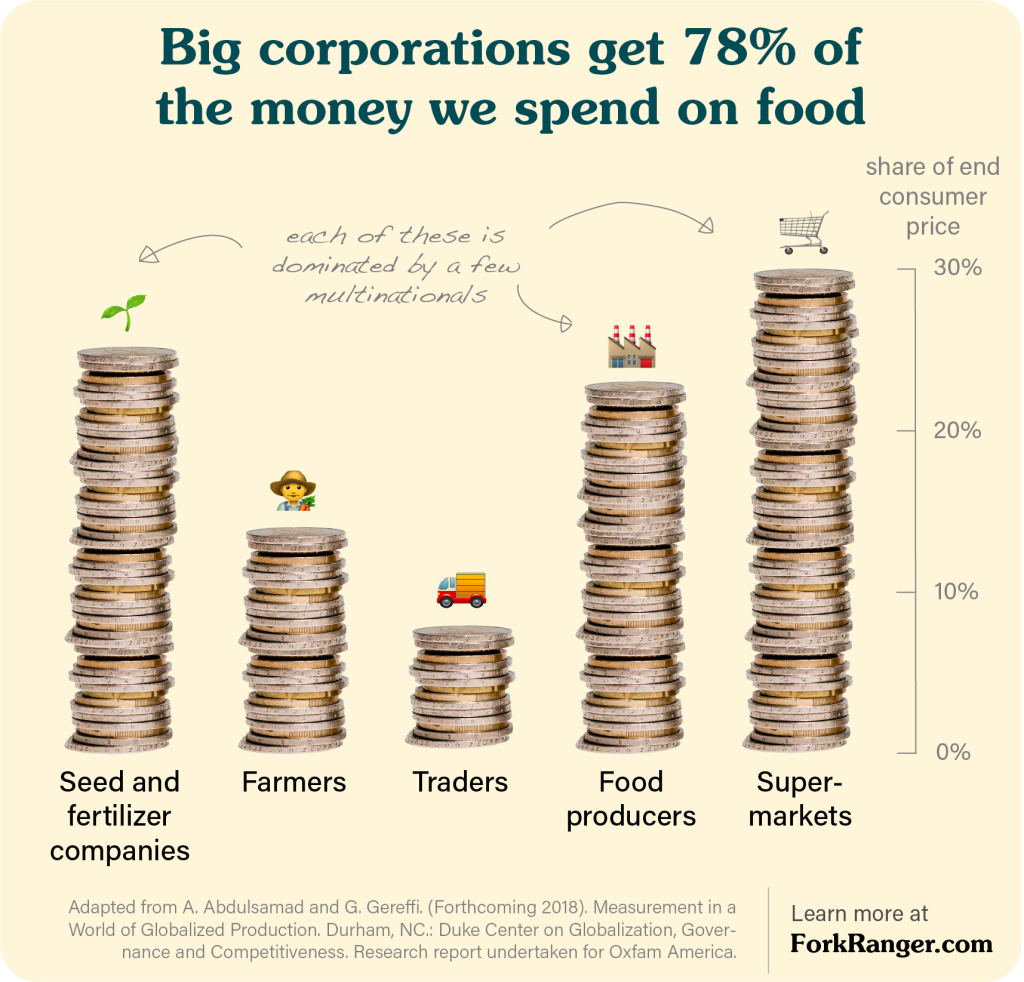
Keep in mind, this is only the money each of these parties receives, not their profits. A UK-study showed that for some products, like carrots, the profits for farmers (and supermarkets) are alsmost zero. This is because supermarkets use low-priced carrots as a product to attract consumers. They choose to depend on other products, including non-grocery, to make up for the shortfall in the contribution from carrots. Consequently, farmers reported to being asked to go even below the sum of their costs. Paying farmers more would have little to no impact on the price we pay for these products, but have a huge impact on the farmers’ ability to be profitable. So the simplest solution would be if we could just trust supermarkets to pay fair prices to farmers, but maybe we shouldn’t wait for that.
The best alternatives for the supermarket: let’s cut out the middlemen
There are farmers who want to be able to set their own prices and get a fair price for their products. What if they sell directly to us and cut out the middlemen? It seems simple: if we pay the farmer directly to ensure a fair price, the farmer must benefit from this. But it is surprisingly hard to find scientific research confirming this. One review about local food systems looked at the following claim: ‘participation in a local food system economically benefits the farmer’. They found out that a lot of the studies focus on comparing farmers who sell part of their produce through local food systems. But they didn’t compare them with farmers who don’t sell local at all. And this exactly is the hard part: farmers often sell their products through local and global food systems. Making a fair comparison would mean disentangling the farm operations and costs. So while it seems simple, it’s hard to prove scientifically because it’s so complex.
But, in an EU-project called Collaborative Agri-food Chains data from 33 case studies was collected and this gives us more insight. The short answer is: short food supply chains also have higher costs and more risks for the farmer, so it’s not so simple. When farmers sell to consumer directly they have to take care of all the things usually done by other parties in the conventional system (selection of the products, packaging of the food if necessary, processing of the food if necessary, transportation to the consumer, marketing and actual selling). This means the farmer needs to dedicate more time, learn new skills, get more people on board, etc. And to cover the higher costs, sometimes, even if we buy directly from the farmers, the price will be higher for us as end consumers.
The GranPrato Bread Bakery example
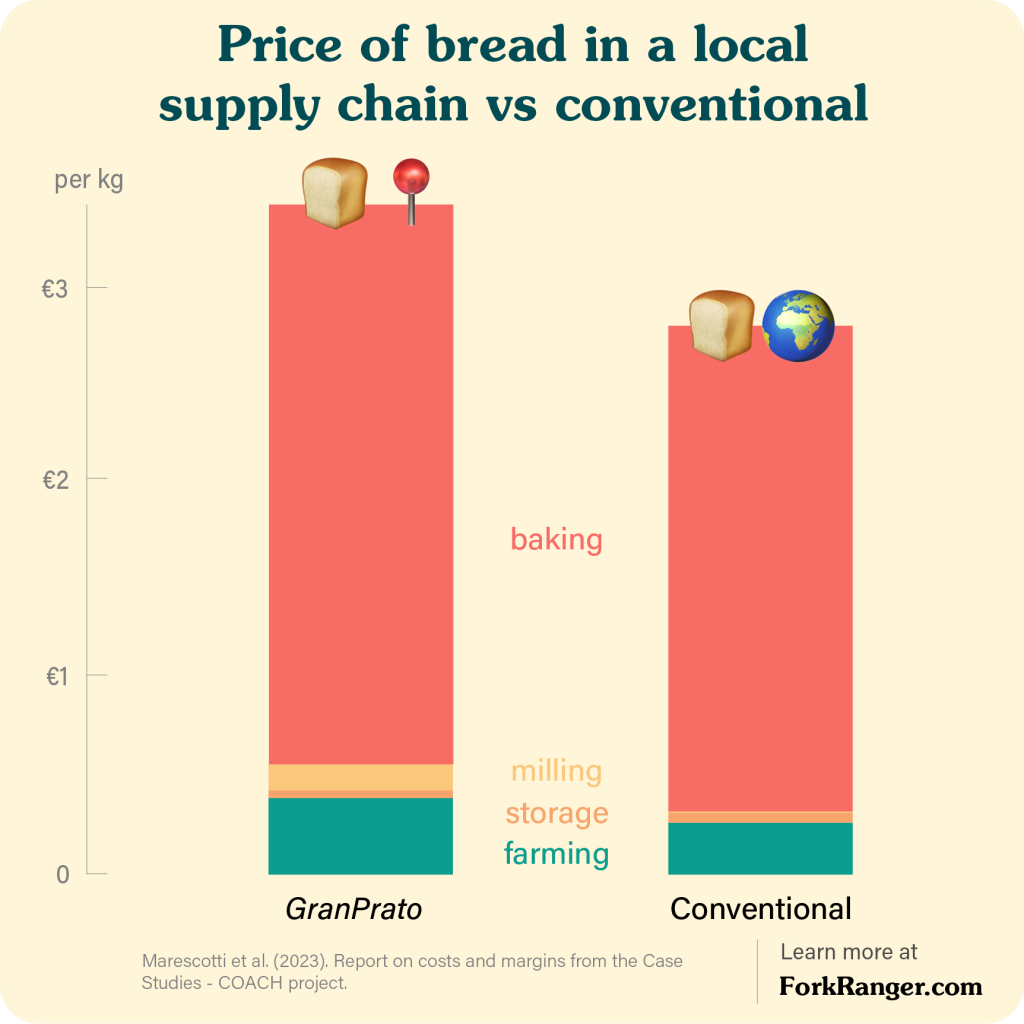
Let’s take the example of the GranPrato bread bakery in this project, as it’s one of only ones where there’s a comparison available. Some participants of the bigger EU-project would not or could not identify a comparable product because they argued it would be comparing very different things (‘apples and oranges’) and would risk portraying their initiatives as performing ‘poorly’ in economic terms. And this is a good point! I decided it was valuable to make the comparison (even though things like benefits of organic farming, more transparency etc. cannot be translated into money), because it’s important to understand what makes the price we pay. Especially in such a price-obsessed country as the Netherlands ;).
Back to the GranPrato Bakery. It was started to create a local ‘zero km’ cereal supply chain. Its main aim was to support local agriculture by enhancing the value of products made from grains produced in the area, in particular the ‘bozza pratese’, a traditional local bread. The members of the supply chain commit to a ‘supply chain agreement’. This agreement requires a fair economic benefit for producers—particularly farmers—and the reduction of chemical inputs, the recovery of good agronomic practices, a focus on organic farming, and the preservation of the characteristics of the original grain, promoting the use of sourdough starters and natural leavening. Now let’s look at the price of their bread compared to bread in a conventional supply chain. First, the raw materials cost is higher. This makes sense as they pay farmers a fair price for the wheat and flour. But other processes also have higher cost. For example, the limited quantities of wheat which are stored in a silo, are not enough to fill up a silo, but of course the price is similar as for a full silo in the conventional supply chain. Smaller local farmers and producers don’t have the economies of scale that larger players have and this can result in higher prices.
There’s a bigger ripple effect of buying local
And then there’s one more thing we shouldn’t forget. The impact of buying local products goes beyond a fair price for the farmer. A very interesting example that’s often highlighted was executed by Ward and Lewis in 2002 with the help of local resident Tim Boyde. He tracked all the finances of the Cornish vegetable box scheme from Cusgarne Organics in the UK. He looked at where the company spent their money within a 25-km radius in the creation of the vegetable boxes, and where that money was then spent afterwards. He found out that the organic box scheme spent a lot more money locally than the supermarket. This extra income to the area was reinvested many times by all the people who received it. Every £10 spent with the box scheme was worth £25 for the local area. If the same money had been spent at the supermarket, it would’ve just been £14. Ward and Lewis then zoomed out and looked beyond food: if every person, tourist and business switched only 1% of their current spending in Cornwall to local goods and services, an additional £52 million (around €65 million) would be put into the local economy annually.
What is the best alternative for me?
Now that we’ve gotten a better understanding of how local shopping helps farmers, and through that the local community, I want to get into action. There are many ways to shop local, from a farm visit to becoming part of community supported agriculture (CSA). With so much variety, there’s a fit for everyone. Let’s explore!
Option 1: You like a good creative cooking challenge
New Zealand spinach, Swiss Chard, Lacinto kale. If you hear the name of a new ingredient, you are immediately intrigued and want to know how it tastes and what you can make with it. You don’t mind an active search for recipes and will try a new recipe even if you find it on a strangely looking website for a small niche community. For you meal boxes with surprise fruits & vegetables, or less known types are a good fit, or joining a community where you simply get a share of everything that’s produced.
Small impact note: this style has as an extra benefit that you eat, what is grown, which helps to better align supply and demand.
Option 2: You have a set of recipes in mind
You already have a few favorite recipes and know what to cook, but you want to get it from local farmers. For you it’s best if you can simply come with your grocery list, and pick what you need from a wide range of products. There are online sustainable ‘supermarkets’ where you can buy directly from farmers, or you can join a food cooperative.
Option 3: You hate picking recipes and deciding what to eat
Deciding what you’ll eat is the hardest question of the week, so if someone can just give you a few suggestions, that’s the best! Besides the conventional companies that offer meal boxes based on recipe selection, there are also plenty of players which offer organic, seasonal, or local meal boxes.
Finding a balance between commitment and time
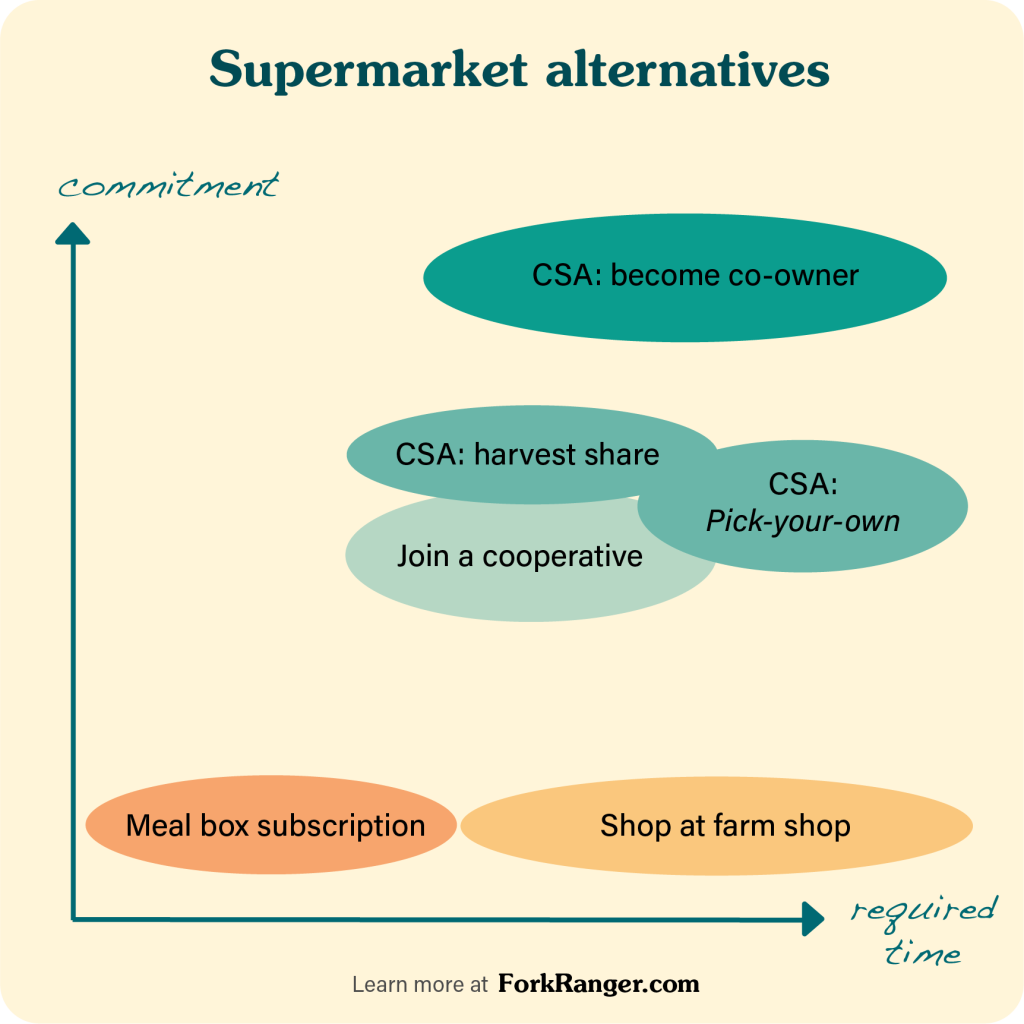
Beyond how you like to organize what you will be eating, the different forms of buying local, have also a different level of commitment. With some alternatives you can shop one time and for others you sign up for one harvest season or you can even become partly owner. While the higher commitment can be a barrier, there are sometimes also try-outs available if you are not sure and want to try it out.
Another thing to consider is time: do you have (or want to make) the time to head out to the farm and help in harvesting? It’s a great way to learn more from where our food comes from, but it doesn’t fit with every lifestyle. Some people even want to ‘save’ time by just looking at the recipes and prefer to skip the whole grocery list part, but of course this comes at an extra cost. I’ve plotted the option so together with the profiles above this hopefully helps you to select the one that’s right for you!
Community supported agriculture
Let’s start with the one with the highest commitment. In community supported agriculture (CSA) a partnership between citizins and farmers is formed. The community members purchase a share of the future harverst. This provides stability for the farmer: they know they will receive an income from their produce and the risks of a disappointing harvest are also shared (rather than all put on the farmer in the conventional system). Different CSA’s have different levels of commitment and required time regarding the expectation to help out voluntarily, to pick part of your produce yourself (at pick-your-own CSA’s) and/or to become partly owner of the farm.
In the Netherlands, there are some bigger CSA concepts that are applied on multiple locations, like Herenboeren oder Lenteland, but also many others, which you can find here.
Sustainable meal boxes
If you don’t want to commit to a harvest share, and don’t have the time to go for a local shopping tour yourself, sustainable meal boxes are a good option. Of course – as with conventional meal boxes – it’s hard to beat going to the supermarkt, as you pay for the homedelivery. However, you also don’t spontaneously drop additional groceries in your cart, that you might not need. So, in the end it’s hard to state how this plays out for you.
You can select one where you pick the recipes or know which recipes you get upfront or be surprised and come up or find recipes yourself. Another reason to choose a surprise meal box, where they determine the selection of fruits and vegetables you receive, is that you eat what’s available and this helps to align supply and demand.
Many sustainable mealboxes are no strings attached, which is useful when it comes to finding the one that fits for you and when you want to skip a week or two because of holidays. But of course it helps these initiatives if you decide to stick to one of them to support them structurally.
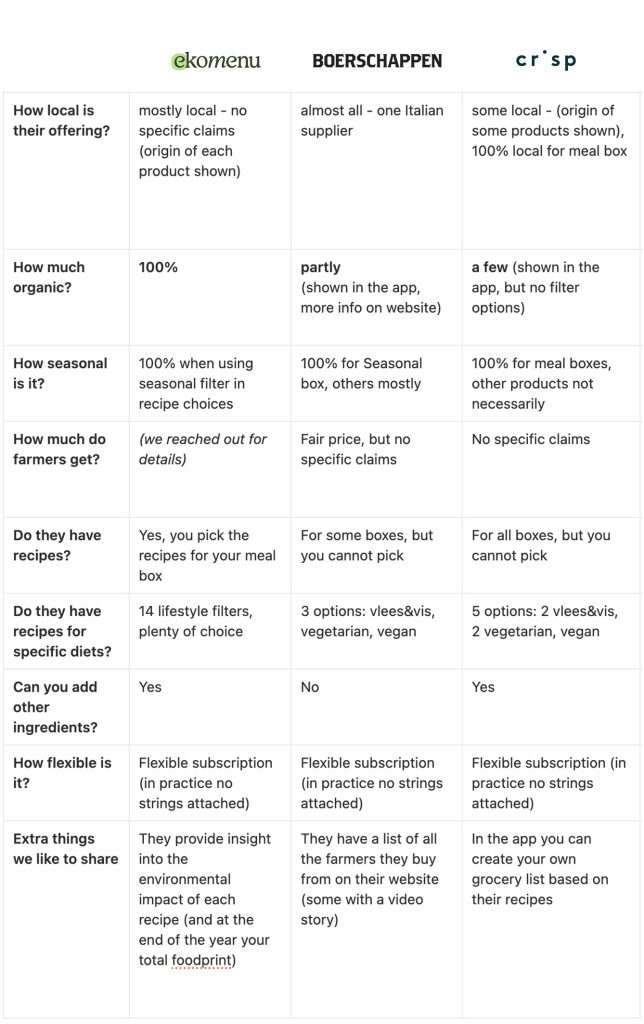
In the table below we’ve looked at a few sustainable options for the Netherlands. Often these buy from farmers in all of the Netherlands, so the defintion of ‘local’ is a bit bigger: the products come from a wider area than one farm in the case of a CSA or a few local farms as a cooperative.
Join a cooperative
A lesser known option is to join a food cooperative. Instead of going to individual farmers yourself and purchasing all your need at different farm shops, you form a cooperation with other citizens and buy the products from farmers together. The food cooperative often has a specific (central) pick-up point, which is also convenient as you don’t have to travel to all the farms yourself.
Except this logistics advantage, there are more benefits. For example, Ons Eten Hilversum collectively buys from Odin (an organic wholesaler that supplies organic supermarkets), which means that they can buy the products for a bit less than they are offered in the organic supermarkets. As an individual person you wouldn’t be able to buy from Odin directly, but because of the bigger volumes in a cooperative, this is possible.
Even though there is not a harvest share you need to commit to, being part of a cooperative typically means dedicating some of your time to the joint initiative.
You can find a cooperative near you in the Netherlands on this map (look for ‘buurtmarkt’).
Farm shops
Maybe the one that comes to mind initially when thinking about buying local from farmers is the farm shop. It’s the most flexible in terms of commitment (it’s okay to go once every now and then – of course the farmer would be happy if you come regularly), but it does cost some time to go there. As we covered in this blog, it’s imporant to visit them by bike or foot, as otherwise you’ll directly loose the expected saved emissions (due to less food miles of the product). You can find a farm shop near you on this map oder many other maps.
Luckily, there are some new initiatives in the Netherlands that make it easier to shop from local farmers, but without going out. For example Oogst, who basically bring the farm shop to your city centre.
While we’ve now tried to categorize the main ways citizens and farmers are connected in local food systems, there are all kinds of cross-overs between these models. We’ve only categorized them to show you that there are ways to shop local for any preference in commitment and time.
Which sustainable meal box to pick in the Netherlands?
For all the other local food options it’s most important to pick one that’s close to you, but with the meal boxes in the Netherlands there are quite a few options. We’ve had a look and compared them for you. Also, we haven’t included pricing, as we are not able to keep this overview up to date and prices are very different depending on which options you select. Note that we haven’t tried them out, so it’s an overview of the information provided by these companies. Let us know if something is missing!
Also, none of these links or mentions are sponsored. We do work with some of these parties (only the ones who we align with mission-wise), as they buy Fork Ranger items for their promotions or we work together on specific blogs and posts.
P.S. Do you think Green Chef is missing? While Green Chef is mentioned in many sustainable meal box lists, we didn’t find their website very informative or transparent on this aspect. That’s why we’ve left them out.
Conclusion
Although buying local is low on our Compass which is ranked primarily by CO2 reduction of different actions, it’s still meaningful. Buying local food from farmers directly has many other benefits.
It’s a good alternative to the supermarket and is beneficial for especially small farmers. In the conventional system large buyers hold a lot of power and this can put prices under pressure. In local food systems farmers can set their own prices. However, farmers also will have more costs to sell local, which explains why the price we as consumers pay is not always lower than in the supermarket even if we cut out the middle men. Still, the effect of buying local products from farmers goes beyond a fair price for the farmer: the whole local economy benefits more than they would’ve when you spend your money at the supermarket.
And you don’t even need to head out to a dozen farm shops to buy your groceries local. There are many different ways to buy local, given the commitment you’d like to enter and the time you have available. So have a look what fits your needs and wishes and see if you shop locally more often.
Vanuit de Ulebelt werken we al een paar jaar aan het actief promoten en opzetten van voedselcoöperaties voor buurtbewoners of collega’s. Zo’n groep spreekt af om met de leden individueel te bestellen bij een aantal zelfgekozen boeren uit de buurt, en samen, bij toerbeurt, te zorgen voor logistiek en distributie. Zo hoeft de boer er niet op uit, en deelnemers halen elke week hun bestelling op bij hun uitdeelpunt in de buurt – garage, speeltuin, buurthuis. Gemakkelijk, laagdrempelig, geen investeringen nodig, jouw euro’s gaan rechtstreeks naar de boer, en met je groepje komt er uitwisseling op gang, over pastinaaksoep en roergebakken palmkool. Er zijn inmiddels meer dan dertig groepen in de regio actief, die samen al voor meer dan een miljoen euro omzet voor boeren hebben opgeleverd.