Pesticides in food: should you be worried?
Main learning: for the average person not eating enough fruits and vegetables is still more harmful than avoiding them because of pesticide concerns
Goal: find an approach that works best for your situation, but most importantly don’t eat less fruits and vegetables
Impact: Medium 🌍🌍🌍⚪️⚪️ as reducing pesticides in our environment in general is important and one of the reasons to increase the share of organic food production (see full Compass)
‘To peel or not to peel’, that’s the question I ask myself looking at the potatoes I am going to eat for dinner tonight. How do potatoes score on the Dutch ‘dirty dozen’? Ah no, they are not among the tested foods, so I don’t know. If I peel them it leads to more food waste, knowing that potato peels are in the first place of partly avoidable food waste. This doesn’t feel right, and how much does it even help? How much of the pesticides would I avoid; are they mostly present on the skin? So does it even help to peel them, or should I just eat them with the skin and not care about it? So many questions, I get completely overwhelmed!
Pesticides have been in the news a lot in recent years, especially when the potential renewal of the glyphosate license came up in November 2023. It wasn’t a smooth approval process in the previous approval either, and the current EU decision to allow glyphosate for another 10 years has been highly controversial. It’s not strange that we worry about the impact of pesticides on our health, most of us do.
So in the end: what’s the best thing I can do? Let me take you through my findings and the decision tree I set up for myself. It might just be what you need as well.
Pesticides – the basics
Before a pesticide is allowed to be used in the EU, the maximum residue level – in short MRL – is determined. This is the maximum amount of residue that is legally allowed to be present in food, based on good agricultural practice, and the lowest exposure necessary to protect vulnerable consumers. While it’s good that we have these limits for the sake of our health, there are some concerns and limitations with the EU’s testing process to determine these limits.
For example, the testing doesn’t cover any interactions of different residue-combinations, so-called pesticide cocktails. But this is the reality: for most of our food, more than just one pesticide is used.
The EU also checks whether these maximum limits are exceeded. In their report (2019) they found that 96.1% of the overall almost 100,000 samples analysed were below the maximum residue level, 3.9% exceeded this level, of which 2.3% were non-compliant. Non-compliant means samples exceed the limit after taking the measurement uncertainty into account. What is interesting: from the samples of imported foods (outside of the EU) a higher percentage (7.8%) exceeded the maximum level compared to food produced within the EU.
But besides looking at these levels per pesticide, the whole story is that 23% of all samples contain 2 or more pesticides, so there could be a cocktail-effect. So while we don’t know more about the cocktail-effect yet, we also know that the majority of foods at least comply with the current limits for individual pesticides. It could’ve been worse I guess…
So, how do pesticides (residues) affect our health?
Okay, now we understand some technical terms but what is the impact on our bodies? Let me start with the uncomfortable truth: there are some things we know, but also quite some things we don’t know. And while we tend to freak out about this, it’s the same for many aspects of our lives, not just pesticides.
The fact that pesticides can be harmful to humans is no surprise, given how farmers need to protect themselves when applying pesticides. And there is a long list of effects that pesticides can have on human health. But it’s all about the levels of exposure. To illustrate this, think about alcohol. If we would drink 100% ethanol, it’s not a good idea, but in limited quantities – like the amount of ethanol in a glass of wine or beer – our bodies can process it. Although it’s no necessarily healthy and or without effects. We find out more and more about the health effects of drinking alcohol. It’s in some way similar to pesticides. The EU sets these maximum residue limits for food to prevent negative health impacts, but at the same time, the process for determining these limits has blind spots as mentioned earlier.
What also know that farmers have a much higher risk of exposure to pesticides – in other ways than just pesticide residues from foods. In Germany, Parkinson’s has been recognized as an occupational disease among farmers. France has been compensating farmers with Parkinson’s for the last three years following numerous scientific studies linking the disease to the use of glyphosate. And it’s not just farmers, also nearby residents have a higher risk of exposure. This study among 35 participants found that around 43% of the bystanders suffered the same level of pesticide exposure as the farmers.
Let me wrap up the different perspectives on the impact of pesticides. It’s not so easy to say ‘they are safe’ or ‘not safe’. While there seems to be no conclusive evidence that consuming food that falls within the safe levels of pesticide residues has negative health effects, there are also some unknowns like the cocktail-effect. At the same time, we do know that pesticides can definitely be harmful to humans at higher levels of exposure. So I guess there is no reason for me to start panicking about the food I eat, but at the same time, pesticide reduction seems like a really good idea for multiple other reasons. More about that later!
Where pesticide residues are found (not just on the skins of fruits and vegetables)
The image that pops up when thinking about pesticides is a person in a white overall spraying a field, or on a bigger scale, a tractor spraying the land. So it’s easy to think that pesticides are only found on the skins of fruits and vegetables. But the thing with pesticides is that some creep into the fruit and vegetable itself. So unfortunately, it’s not as easy as washing pesticides off with water.
What we do with fruits and vegetables affects the amount of pesticide residues
There are some processes that help to break down pesticides before we eat food.
Researchers have gathered a lot of studies on the effects of washing, peeling, heat application (like frying), canning, and the effect of storage. But there is not one uniform result for these activities: there are a lot of factors influencing the reduction of pesticides. And also results vary even for the same amount of pesticide from food to food.
In general, they found the following results: washing foods gave varying results from 10% to 100% of removal of the pesticides. Besides washing, peeling was another removal method, but it only works for pesticides on the skin, and not for any pesticide within the fruit or vegetable. At the same time, peeling removes valuable nutrition of a fruit or vegetable in the case of edible skins.
During cooking, some pesticides are also broken down with a similar spread of results as washing, depending on the time, temperature, etc. While it might be effective in some cases, who wants to eat blanched cucumber? Yuck! So while cooking can significantly reduce pesticide residues, it’s not always a preferred method.
How about canned foods? Canned foods often undergo processing steps at the factory, including washing, peeling, blanching, etc. That’s why the pesticide residues will be reduced, similar to if you would wash, peel or cook fruits or vegetables yourself. In the case of canned tomatoes for example, the heat treatment alone already reduced one type of pesticide with 71-86% and another with 31-45%. So that’s why most of the articles about pesticides focus mainly on fresh fruits and vegetables.
Once pesticide residues are washed off – either in our own kitchen or in an industrial factory – the pesticides make their way to the wastewater treatment. These treatments are designed to filter harmful products before the water is discharged. However, also discharged water could contain some pesticides. I didn’t find a lot of research on this unfortunately, but it seems that pesticides from farming entering our waters – which we use for drinking water – receive more attention than the impact of pesticide residues after leaving the wastewater treatment.
They’re not just found in fruits and vegetables but also in other products
So far we have just been talking about fruits and vegetables. But pesticides are used for all kinds of food products, like oats, other grains, nuts, and residues can also be found in animal products. It’s not limited to fresh fruits and vegetables: pesticides are used on almost all plants we grow.
Processed foods have undergone many steps like washing, drying etc, at the factory. Those activities have already removed quite some residues, so it’s more likely that their residues are lower.
Is buying organic the solution to avoid pesticides?
So rather than trying to limit the pesticide residues after I have bought these conventional potatoes, does it make more sense that I avoid them altogether by only shopping organic next time?
While we often say that organic food production uses no pesticides, we mean no chemical pesticides. It’s allowed to use natural pesticides in organic food production, and just as with conventional food production, they also have their maximum residue limits.
The good news: EU research has shown that significantly fewer pesticide residues were found in organic foods. The bad news: even organic foods have been found to sometimes exceed the limits. Let’s take a closer look at the exact numbers from that 2019 EU report.
- Organic food products more often have no detectable residues (86,6%) compared to conventional products (54,2%).
- Organic food products less often have residues within the limit (11,9%) compared to conventional products (41,7%)
- Organic food products less often have residues that exceed the limit (1,3%) compared to conventional products (4,1%)
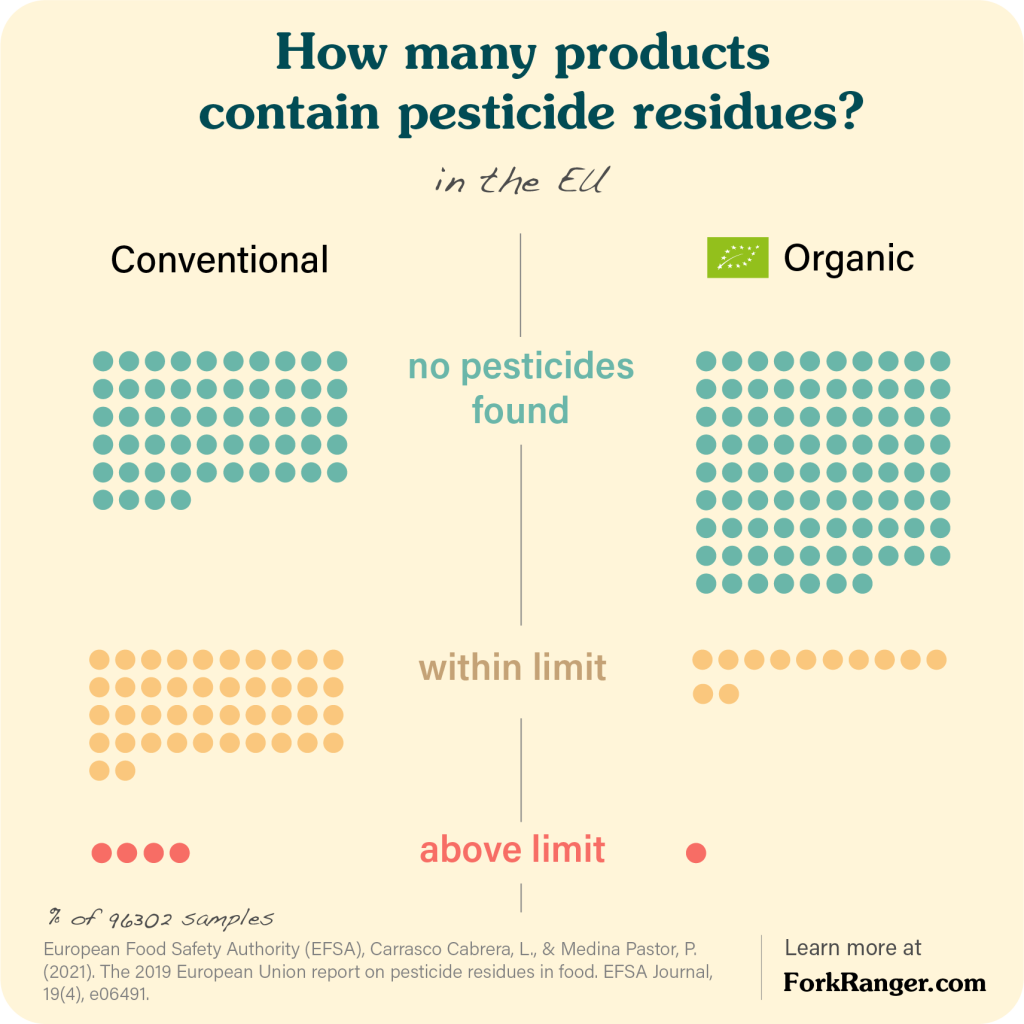
This clearly shows that switching to organic food is a good idea to further reduce pesticide residues (if you can afford it). Also, keep in mind that it’s not a zero-sum game. It’s not all or nothing. Buying some organic products is better than none at all.
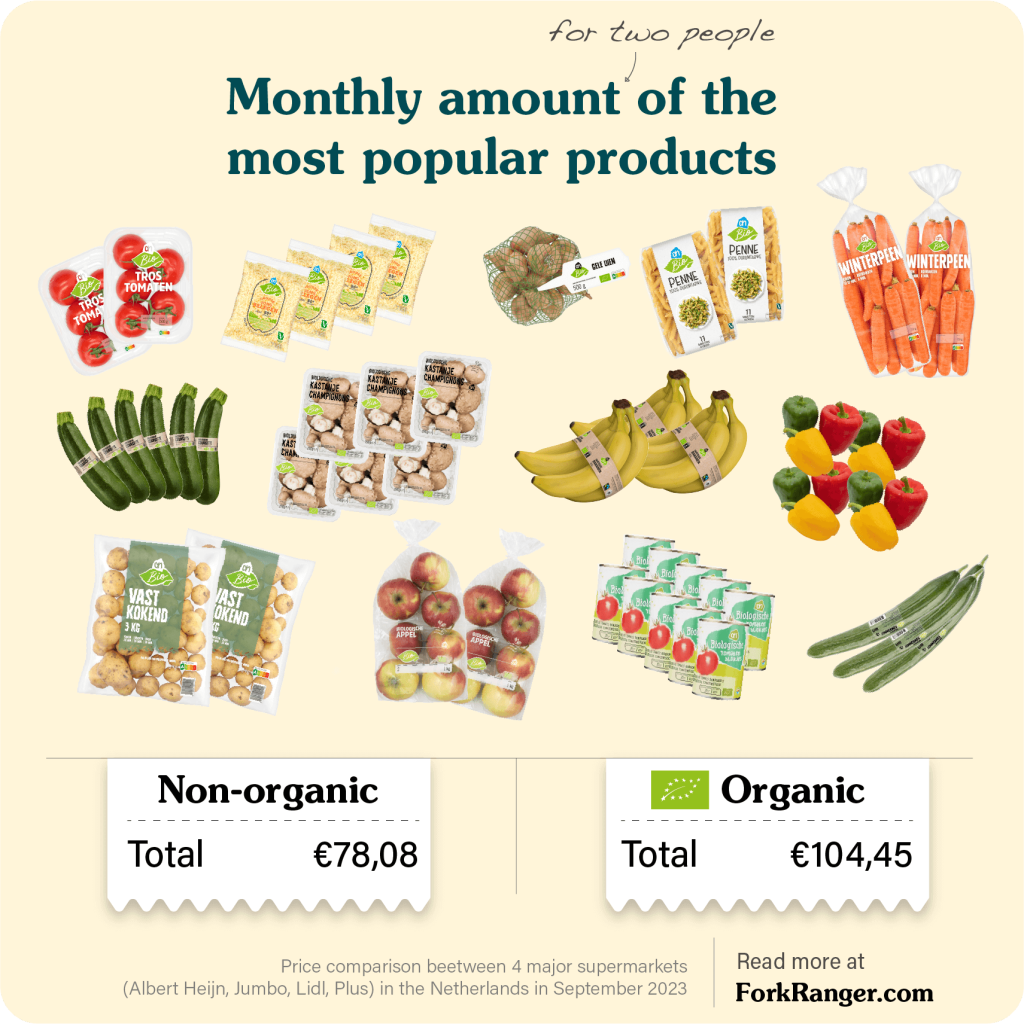
So if you’re grocery shopping with a limited budget, focus on buying some products organically, especially the ones you eat raw and often. We’ve had a look and for just 25 EUR a month extra (on top of a 500 EUR grocery budget for two people), we could buy a lot of foods organic which we eat often. Read our full blog about buying organic on a budget here.
Beyond our health, there are more reasons for the reduction of pesticides
There are other good reasons why we want to reduce and limit pesticide use. I kept this list short, as I can start a whole new blog about this. But don’t take the short summary as an indicator of its importance.
By the way, it’s not just the public wanting to reduce pesticide use, the EU itself even has set targets on reducing chemical pesticides with 50%.
Why we should reduce pesticides:
- Our farmers have an increased risk of being exposed to pesticides. In the testing process, the dietary exposure is evaluated, but not the everyday exposure for farmers and nearby residents. And while some exposure can be limited by wearing personal protection, this is not always the case. PAN Asia Pacific have reported that farmer’s main reason was that personal protection equipment is unaffordable, uncomfortable, or unavailable.
- A lot of pesticides, especially those targeted to insects, also negatively impact pollinators. And this is worrying, especially as pollinator populations are already declining. In the past already some pesticides, like types of neonicotiniods, have been restricted by the EU to protect honeybees.
- A lot of pesticides are washed off and end up in our waterways where they harm other life.
Back to my potato case
Besides the general information we’ve covered, I looked for some specific information about potatoes. Let’s take a deep dive into potatoes to see what lessons it holds for us in general.
The EU sampling indicated that almost three-quarters of potatoes had no detectable pesticide residues. They found that 0,8% exceeded the maximum limits.
Another study gave insight into the location of those residues. Most of the residues were found on the skin of the potatoes, but some were found within the potato as well. This also explains why other studies found that peeling them was quite effective, removing three-quarters to all pesticides. What about washing them instead?
Just washing them with tap water removed 10% in one study and another 24% of the studied pesticides, while washing them in acetic acid and natrium chloride solutions increased this to circa 50% or 100% removal in the first-mentioned study. It also sounds like a hassle to make special solutions for this.
Peeling seems easier, but if I would peel them, I would lose the dietary fiber, as 1-2% of dietary fiber in potatoes is concentrated in the peels.
Frying the potatoes after all the prep would reduce the residues even further, so that only a little of the original residues is left.
So in the end it probably depends on whether you are a potato fan or not. I don’t eat a lot of potatoes and the presence of pesticides after the tap water washing and frying (even with the peel) doesn’t seem super high. So I would probably care more about making better decisions for all the pasta and rice I eat.
But for all the huge potato fans out there: I’ve also figured out that it wouldn’t cost the world to buy organic potatoes. For just 1 euro extra you can buy a 3kg bag organic instead of conventional. If you can spend this, it’s just one decision rather than getting stuck in the dilemma of ‘to peel or not to peel’ and washing with special solutions. And on top of that, choosing organic would be a win for the climate, too. But if you can’t afford it, remember that you can easily wash them with tap water, you’ll be cooking them anyway and for the far majority, no residues were detected.
Conclusion
While we don’t have the time to research every vegetable like my potatoes, there still might be some overall approach we can choose. Let me start by saying that it’s impossible to 100% avoid pesticides: organic products might contain residues of natural pesticides, the wind might carry pesticides from the neighbouring sprayed farm field to your own vegetable garden. But that also doesn’t mean we can do nothing about it. This is the decision tree I came up with:
1. Don’t eat less fruits and vegetables
The majority of fruits and vegetables complies with the health and safety standards set by the EU and don’t exceed the maximum residue limit. While we don’t know exactly how different pesticides interact and their consequences for our health, we do have enough scientific evidence to say that diets low in fruits and vegetables cause significant harm. Diets low in fruits and diets low in vegetables are ranked 3rd and 5th place in global deaths and so-called life years lost attributed to diet. So let’s focus on what we know and not reduce our fruit and vegetable intake as we know for sure that this will have a negative impact. A Canadian study modelled exactly this trade-off and found that for each estimated case of cancer triggered by pesticide exposure, at least 88 cases were deemed prevented by the consumed fruits and vegetables. They conclude that the chronic health risks investigated are low and the health benefits of fruits and vegetable consumption far outweigh the pesticide-related risk.
I am not saying we should sweep the concern for pesticides under the carpet, but it also shouldn’t stop us from eating sufficient fruits and vegetables.
Secondly, we can then have a look if we want to buy differently, especially for products we don’t intend to cook. So for the following tips, keep in mind that it is most important to focus on the unprocessed foods that you eat a lot of in their raw form. While those will be mostly fruits and vegetables, don’t forget for example oats for your breakfast.
2. Buy organic or grow your own food
Organic food products have been grown without chemical pesticides and contain significantly less pesticide residues. With some smart shopping, you can even buy quite some organic on a limited budget. And if you’ve got the time, try setting up your own vegetable garden or become part of a communal effort to grow your own food 🤩
3. Buy frozen or canned
These food products already often contain less pesticide residues because of the processing steps at the factory 😌
4. Wash (with baking soda)
This can reduce some pesticides, but the results vary a lot. There is a study that promotes washing apples with some baking soda, but this hasn’t been proven useful for all fruits and vegetables. But on the other hand, simply washing with water is also not the hardest thing to do, so why not? 😁
5. Peel
This can reduce the pesticides that are present on the skin of fruits and vegetables (but not the ones within). On the other hand, you also throw out valuable nutrition, which is a compromise on your health and the climate 🤷♀️
Besides deciding for ourselves what we buy and eat, we can also let our voice be known to the decision makers and demand less pesticide use and a stricter policy. This is not only for the benefit of our own health, but also for our farmers and the living world around us, which sustains us. The next upcoming possibility in the Netherlands – after publishing this blog – is to join the PesticideVrij-dag on 11th of April 2025.
Top artikel, dank je wel hiervoor!