5 microadventures to discover sustainable food pioneers
Main learning: while our food system in general is broken, there are also a lot of hopeful initiatives around, it’s not something of the future, it’s already happening
Goal: go outside and discover a sustainable food pioneer near you!
Impact: Low 🌍⚪️⚪️⚪️⚪️ if you look only at the impact of reducing food miles through buying local food, Medium 🌍🌍🌍⚪️⚪️ if you buy more organic food and High 🌍🌍🌍🌍⚪️ if these local initiatives give you hope and encourage you on your own sustainable food journey (see full Compass)
If we are tired of all the negative climate news, the best way to stay hopeful is to see the future happening right now, even if it’s on a small scale. It also proves that we are not alone, we are not the only person that cares of making a difference through food. Let’s discover some sustainable food pioneers!
And how can it be more fun than combining it with a microadventure? At Fork Ranger we are very enthousiastic about exploring the outdoors, and one person who has made that more easy and fun is Alastair Humphreys. In his book Microadventures (he coined this term), he explores all kinds of adventures that don’t require a holiday but can fit in our everyday lives.
Using microadventures as an inspiration, we’ve created a few micro food adventures for you. But before we get to those, let us look at the role of local food in eating more sustainably.
The climate impact of local food
One of the reasons people are motivated to eat local food, is to reduce food miles: the distance our food has travelled from where it was grown to our plate. The food in the supermarket comes from all over the world and transport is (still) heavily dependent on fossil fuels. So eating locally, reduces the emissions from our food, is the thought. While this is true, the amount of saved emissions is often overestimated. Most of the food emissions come from the production on the farm.
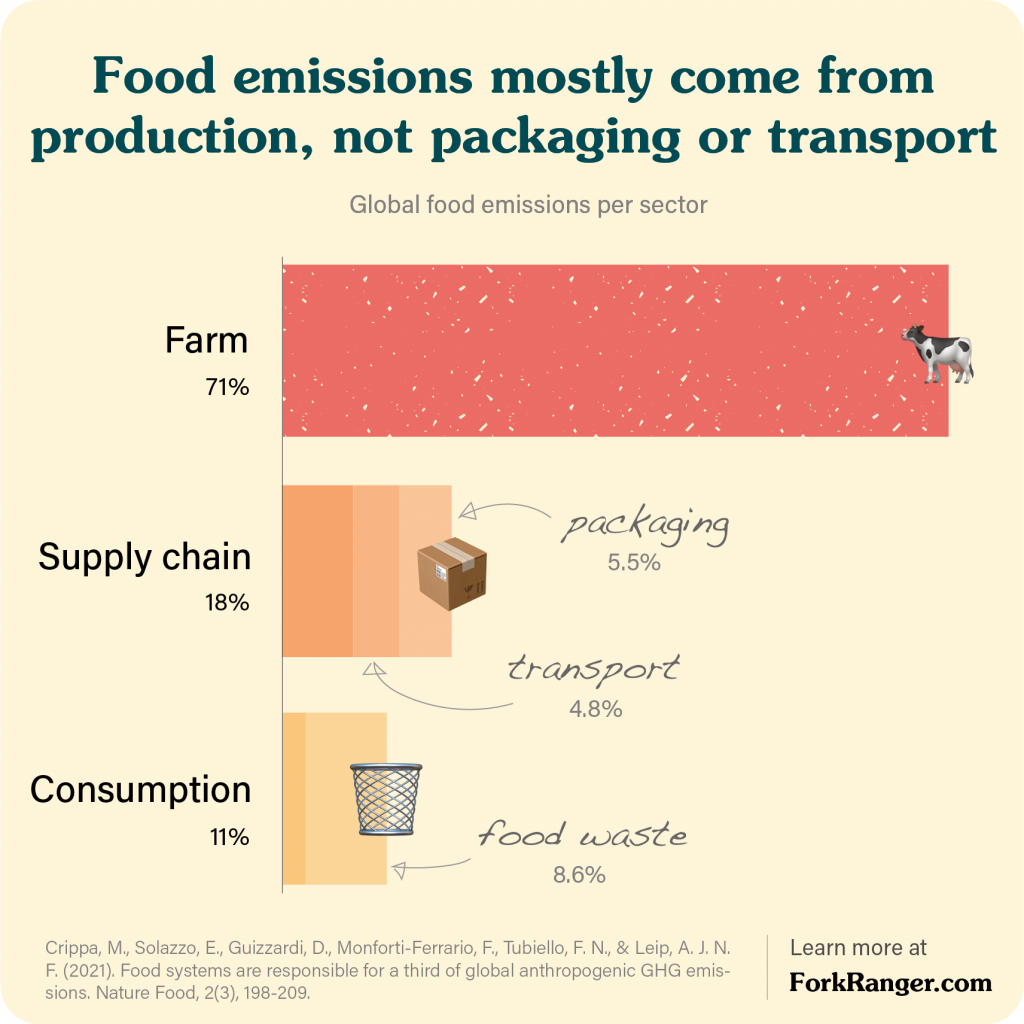
Only 5% of the CO2 emissions of food are caused by transport. This is a lot less than people think. So instead of buying all the food of the current diet locally, eating less meat and dairy, is a far more effective action to reduce the impact of your diet. Simply replacing beef by other meats – not even eating less meat – already reduces the footprint of your diet by 21%. So, that’s 3-4 times more effective than buying all your food local. If you ever wonder how other actions related to your food compare, have a look at our Compass.
Nevertheless, it doesn’t mean that buying local food is useless at all. But it’s also easy to increase emissions without realizing the impact of your own transport choice.
The most sustainable way to purchase local food
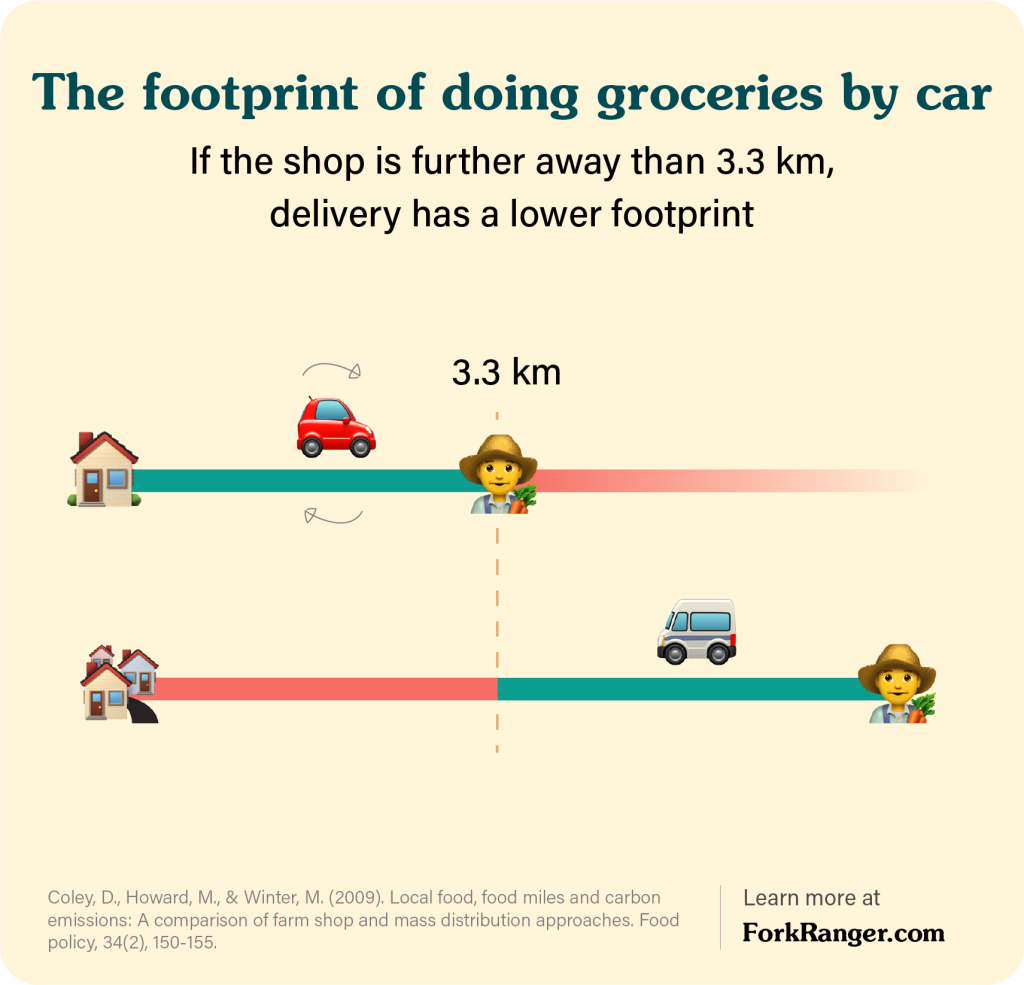
If you decide to purchase local food, it matters how you go to the local shop: by car, by foot or by bike. Look at it this way: it costs a certain amount of energy to transport weight over a distance. You can imagine that transporting you in your 1000+ kg car for a shopping bag of local vegetables costs a lot more energy than your share of a delivery transport carrying local vegetables for multiple households. The tipping point lies at around 3.3 km. For a shorter distance the emissions of your own car transport are less than that of the delivery, but for a larger distance the delivery transport has lower emissions.
But of course the best way to add no emissions at all is to go by foot or by bike. And you’ll get some excercise and fresh air too! That’s why micro food adventures are an excellent way to discover new places that are part of a sustainable food system.
Why local food initiatives are still valuable
Despite the limited potential to reduce CO2 emissions compared to other food climate actions (check our Compass!), local food initiatives are still valuable. There are many different ways in which local farmers are connected to local consumers, so it’s hard to find conclusive general scientific evidence about the benefits of local food initiatives.
Climate friendly farming practices
While it’s not a guarantee that local foods are sustainable per definition, we found during our route planning of the micro food adventures that local food initiatives often use sustainable farming practices, such as organic farming. Even if their products might not be labelled as organic, it’s best to ask local farmers about their practices, to know more about this. Make sure that you have a look at the websites to learn more about the farming practices at the micro food adventure stops.
A sense of community
When consumers are asked about why they buy local food, it can be summarized as bringing about a sense of community. For example, consumers want to support local farmers, build social relationships with farmers, and foster the well-being of their own community. What is interesting is that research also found that the social bond only holds as long as their own respective interests are fulfilled (i.e. profitability and control for farmers, and access to healthy, affordable food for consumers).
One of the local food formats in which there’s not just a sense of community but it is an actual community: community supported agriculture (or short CSA). The difference is commitment from the consumer’s side: this is high, compared to many other local food formats like a farm shop. For a CSA a group of people pledges to the harvest of one farm and share the risks and benefits of growing food. So if you want to not only create a sense of community but create or contribute to a real community, have a look which CSA’s are present in your area. It might not only lead to tasty local food, but will inspire new friendships. But keep in mind: it will also ask some commitment from you. The micro food adventures also will lead past a few of them and you’ll have plenty of time along the way to think about whether this fits you.
Rural development
There are various ways in which local food could lead to rural development. Local farm shops for example can attract people that visit areas people otherwise wouldn’t visit. And because of that other local businesses might also benefit from that. Maybe you are one of them, when you stop for a coffee break along the route? Sometimes farmers even combine growing food with tourism and you can spend the night at the farm. And if processing of the food happens on site or nearby, this means rural jobs are created. While all these things have a positive influence on rural development, another study has also found that better medical care, transport services and faster internet might have an even greater influence on rural development.
More appreciation
One of the aspects for which this review found more supporting evidence was appreciation. Selling locally makes farmers often feel recognised for their role in the local food system. So – to me somewhat surprising – this is often the main reason for them to participate in local food channels. But after digging a bit more, it made sense. A UK study found that the lack of public appreciation, understanding of their job and the pressures and challenges they are dealing with, can lead to loneliness. So buying local is also a way of saying ‘thank you’ to the farmers who provide one of life’s necessities.
So, if this is the case, shouldn’t we just base our whole food system on local food? As we are now increasingly living in cities, it’s not possible to move to 100% local food for everyone. We simply cannot grow all the food nearby. A 2020 study found that only 11–28% of the global population can fulfil their demand for specific crops within a 100-km radius, with substantial variation between different regions and crops. For 26–64% of the population, that distance is greater than 1,000 km.
Discover local food initiatives with 5 micro food adventures
We’ve created a few routes in different parts of the Netherlands, for once not starting in Amsterdam or Utrecht ;). All routes start at public transport hubs, so you can get to the route in a sustainable way. And all routes include different local food formats.
Let us know how you like them: should we create more? It’s one of my ideas to create a book with routes throughout all of the Netherlands, should we make this happen? Simply email Mareike: mareike@forkranger.com.
Check out the routes below:
- North of the Netherlands 🚲 starting from Assen
- East of the Netherlands 🚲 starting from Lochem
- Central in the Netherlands 🥾starting from Bunnik
- West of the Netherlands 🥾 starting from Leiden
- South of the Netherlands 🥾 from Etten-Leur towards Breda
Tip: always check online the most recent opening times and offered activities. We try to keep it updated, but can sometimes miss something.
Why did we choose Komoot for the routes?
- we can plan the route better than with Google or Apple Maps
- you can use it for free (if you don’t mind about the real-time navigation, you’ll still see where on the route you are)
- you can make your own adaptations to our proposed route
- we can add more information about the stops in the komoot route later (for now this was not possible, hence the stops are shown in the separate route webpages)
Conclusion
Local food might not save a lot of CO2, but it’s still valuable to buy local products. When you’ve just started out eating sustainably, focus on the eating less meat and dairy first. Still, a delicious local meat or dairy product could help you to treat it as a luxury. So in that sense, it will help save CO2 in the end. When you head out, make sure you go by foot or take the bike, so you don’t add extra food miles when you get the produce. When you’ve already optimized what you eat to sustainable amounts, buying more local food is a great way to be more involved in how your food is grown. While it’s not a guarantee that “local = sustainable”, many local food producers do adopt sustainable farming practices. Simply ask the farmers! And this is important after you’ve tackled eating less meat and dairy, as eating more organic foods is higher on the priority list for a sustainable diet than eating locally.
We hope the micro food adventures help you see the different local food formats and spark your curiosity to where your food comes from. Have fun exploring and let us know how you liked them!
Other tips
If you don’t live near any of these proposed micro food adventures or if you want to design your own, here are some resources you can use (live at the time of writing):
- Check our this Regeneration map for the Netherlands with all kinds of local food initiatives.
- Join one of the Herenboeren CSA’s or find another CSA here.
Feel free to post initiatives outside of the Netherlands below.