Why the benefits of seasonal food can’t be measured in CO2
Main learning: eating seasonally is important for various reasons, but it’s more important to eat less meat and dairy to reduce our CO2 emissions
Goal: use your motivation to eat seasonally to make vegetables the main stars of your meals
Impact: Low 🌍🌍⚪️⚪️⚪️ if you look at just the impact of eating seasonal vegetables instead of non-seasonal vegetables but Very High 🌍🌍🌍🌍🌍 if you switch to our seasonal recipes and also eat less meat and dairy (see full Compass)
When it comes to eating less meat there is lots of resistance but for seasonal food it’s a whole different story. In one study, eating more seasonally was the action that people were most willing to take, along with reducing food waste.
But what do the numbers say? What’s the impact of eating seasonally?
What is seasonal food?
Eating seasonally is about eating fruits and vegetables when they are harvested. But something could be from halfway around the world and still be in season because there is a difference between global and local seasonality.
For example, if you live in the Netherlands and it’s summer, you could get apples from New Zealand where they are in season at that moment. This is called global seasonality. In the Netherlands, apples are harvested early fall so that’s when apples would be locally in season.
The New Zealand example seems silly for other products it’s in many cases still better to grow something in season and transport it, than to grow something out of season in a heated greenhouse.
We are going to use the definition of local seasonality.
The impact of seasonal food in the average diet
Seasonality only affects the carbon footprint of fruits and vegetables. And compared to animal products, they have a much lower footprint. A tomato is one of the highest-impact vegetables, but even the worst tomato is five times better than the same amount of cheese.
In other words: seasonal food can reduce your footprint, but it only covers a part of your diet that already has a low footprint. So overall, eating seasonally is not one of the top priorities when it comes to eating for the climate.
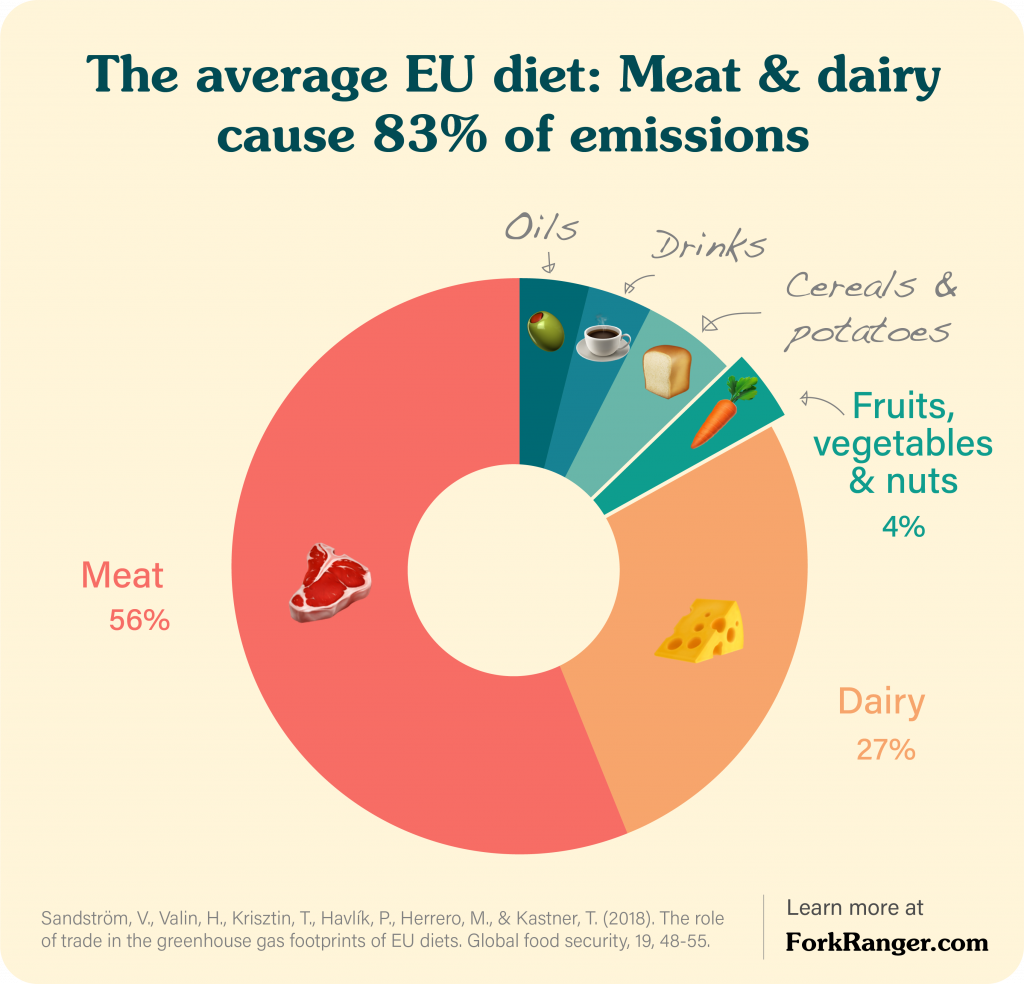
Of course this refers to the average diet. If you’re already eating meat and dairy at a sustainable level, fruits and vegetables play a much larger role and seasonal food becomes more important.
When seasonal products make a significant difference
There are two scenarios where choosing seasonal products can really reduce the carbon footprint of your food.
1) If the product is otherwise transported by air
Air transport has a huge carbon footprint but only very little food is transported by air. Read more in our blog post about air transport.
The products that come by air if they are not in season:
- Berries
- Asparagus
- Green beans, peas, and sugar snaps
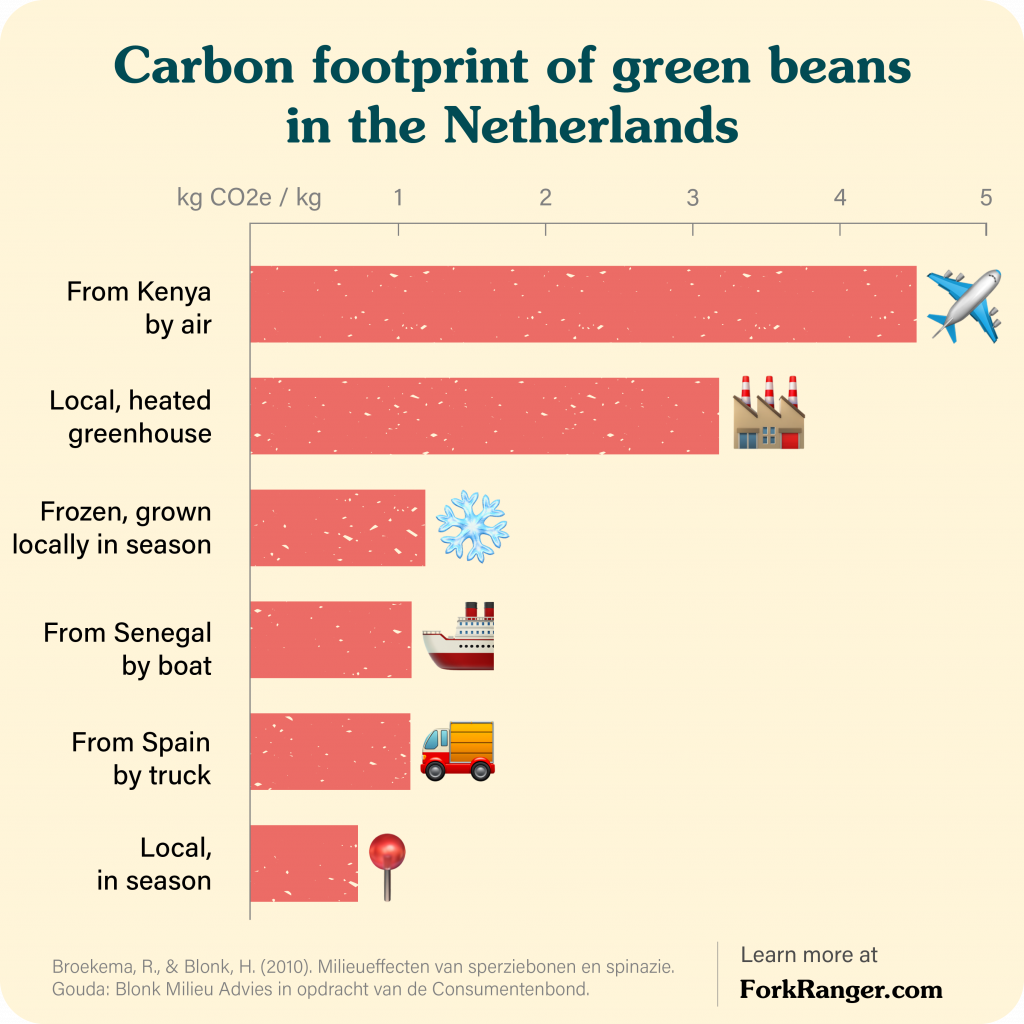
2) If the product is otherwise grown in a heated greenhouse
As you can see in the graph, spinach from a greenhouse has an almost three times higher footprint than seasonal and local spinach.
What’s interesting is that the location matters less than whether it was grown in season. That’s because the bulk of emissions usually come from production, not transportation.
Growing something in season and then storing it in the freezer also adds little emissions.
Especially Mediterranean style produce often requires heated greenhouses and has a higher footprint if you buy them out of season. In the Netherlands, the major products from greenhouses are:
- Tomato
- Cucumber
- Bell pepper
- Eggplant/aubergine
- Strawberries
The benefits of seasonal food
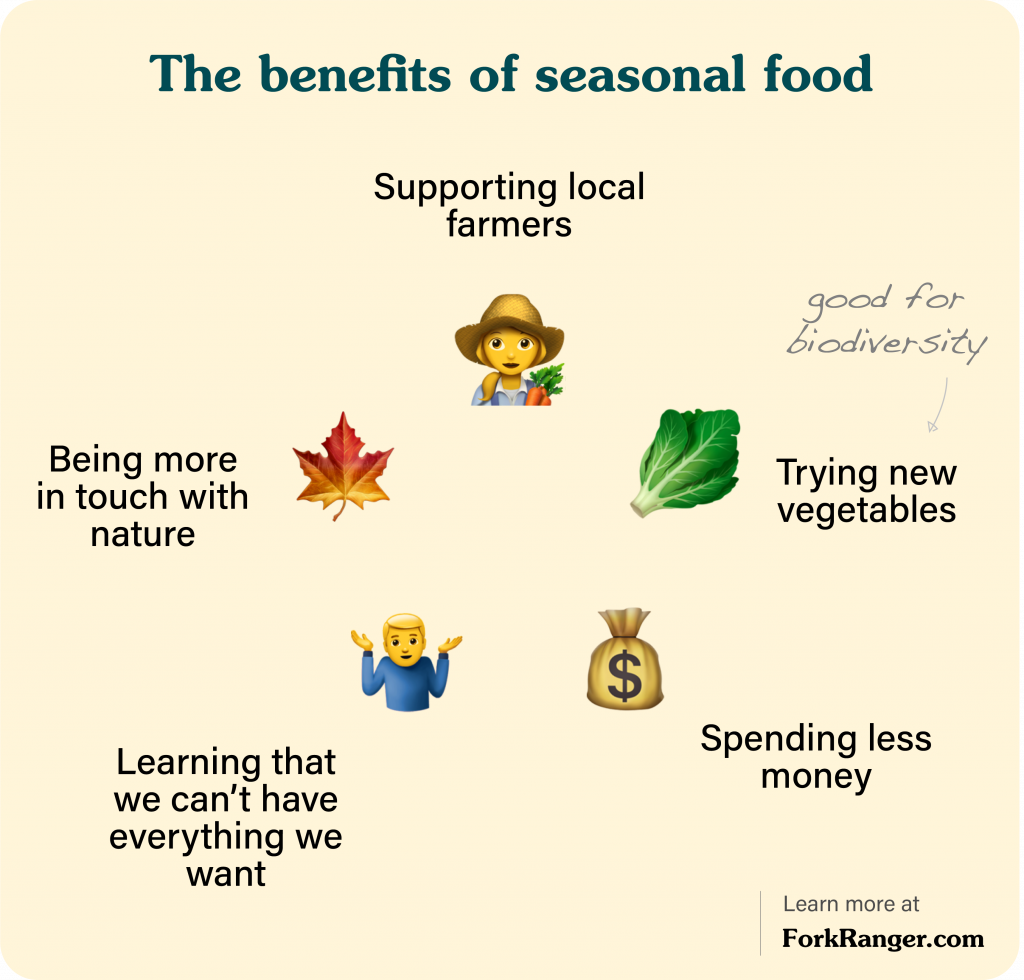
It’s important to take a look at the carbon footprint, but sometimes there are also good reasons that can’t be expressed in numbers. Even though seasonal and local food doesn’t make a huge difference in the current food system because of the high emissions of meat and dairy, it is still an important part of a sustainable food system.
Connection with nature
More and more studies show the benefits of being in touch with nature: you become less stressed, more focused, more relaxed and much more. Eating seasonal food is another way to be in touch with your environment and the natural seasons. It’s hard to put into numbers, it just feels good. And it’s important to nurture this feeling.
Supporting local farmers
A Dutch farmer can only harvest kale or cabbages during winter. If nobody eats them and we all buy imported zucchini and tomatoes, the farmer is left with these winter crops. Eating seasonal food means being in sync with the farming schedule. And that means local farmers are more supported to farm in harmony with nature.
More likely to try new vegetables
Eating seasonal food means eating cabbages or other underappreciated foods. This not only supports biodiversity as we eat a wider variety of vegetables but also makes our plates and tastes more diverse. Eating more diverse veggies is healthy and helps to create a culinary culture that is less centered around meat.
In this way, eating seasonal food can be an entry point to discover how food can help us solve the climate crisis. This was the reason we started working on a seasonal calendar: it helps people to understand what’s in season and gives recipes without meat and very little dairy, striking two birds with one stone.
Embracing limitations
Seasonal food helps us understand that we cannot always get everything we want all the time. We cannot solve the climate crisis without accepting this simple truth.
Seasonal food is cheaper
Vegetables are on average 13,1% cheaper at the end of summer – when most things are harvested – compared to the prices at the following end of winter.
Practical tips
- Pay extra attention to Mediterranean vegetables and products that come by air (berries, green beans, asparagus)
- Choose the frozen or canned option if something is not in season
- Buy food that is in season in your wider region
- Get our seasonal calendar with recipes 😉
Conclusion
In the big picture about reducing the carbon footprint of your food, seasonal food has a relatively low priority. That’s because fruit and vegetables already have a much lower footprint than meat and dairy. Reducing meat and dairy consumption is the most important step and could be described as phase 1 towards a sustainable food system.
Once you’ve done that, eating seasonal food can also reduce your footprint. But more importantly, it’s a great way to support a farming system that is more connected to nature. In this way, eating more seasonal and local food is phase 2 of creating a sustainable food system. It helps us appreciate more vegetables and brings us more in touch with nature and the seasons and variations of our local food system.
Hello Frank Thank you for your infographic on the proportion on average population consumption per commodity group. I’m astonished to see how small a proportion vegetables are consumed despite such strong messaging from health professionals and government bodies and public food engagement policies. What is the source of these figures?
No mention of health and nutritional benefits of low carbon products is highlighted. What is the reasoning behind this? Also a red meat image is depicted as representing meat. Why not chicken when 80% of meat consumed is from poultry fed on imported soy protein. Thank you
Hello Diana, I assume you are talking about the first infographic shown in this blog post. It shows the emission per food group, not the amounts we eat. So while we eat quite some vegetables (looking at weight of this food group), it has a low climate impact. For meat, the highest emissions come from red meat so that’s why we use this emoji here, so people connect the fact that red meat leads to a lot of emissions (much more than chicken). You can always find the source of the infographic in the small print of the infographic. Hope this helps!
Hi
Thanks for all the shared information!
There are two kind of greenhouses
1) the heater is just burning fuel/gas/coal/wood and heat the greenhouse
2) the heater is in fact an engine that produces electricity and the residual heat is used to heat the greenhouse.
Which one did you use for your infographic?
Thanks
Hi Georges,
The source we used for the infographic (I assume you mean the one about green beans), does only specify the heating source (natural gas), but doesn’t comment on the technology used. I do believe heating strategy 2 which you mention is quite common in the Netherlands, so I would assume that the potential benefits of that have already been included in the study. Hope this helps!
May the forks be with you, Mareike
Goedendag,
Wat een duidelijk artikel, dank hiervoor!
Zijn potten, blikken of ingevroren groenten nog even rijk aan voedingsstoffen als verse groenten?
Groetjes Anne
Hi Anne, dankjewel! Het is ongeveer gelijk, zie hier ook het antwoord van het Voedingscentrum: https://www.voedingscentrum.nl/nl/service/vraag-en-antwoord/gezonde-voeding-en-voedingsstoffen/is-verse-groente-gezonder-dan-groente-uit-pot-of-blik-.aspx
AUB De belangrijkste voordelen van seizoensgroenten zijn niet genoemd, gelieve dit te corrigeren: 1) Ze zijn VEEL gezonder want op natuurlijke(r) wijze geteeld. Een groot deel van onze welvaartsziekten hangt momenteel samen met gewassen die bijna geen vitaminen of mineralen hebben. Dit is reeds wetenschappelijk aangetoond, doe jullie research aub. 2) Lokaal geteelde seizoensgroenten hebben VEEL meer smaak. De huidige groenten smaken naar niks vergeleken met dezelfde groenten decennia geleden geteeld. Smaak is een cruciale barometer voor hoe gezond groenten zijn. en niet alleen een culinair extraatje. 3) Lokaal geteelde gewassen zijn doorgaans veel rijker in variëteit. 4) Op deze manier hoeven groenten minder bewerkingen te ondergaan om smaakvol te zijn (te veel suiker/additieven in sauzen, stimuleert meer mensen zelf te koken)