How healthy is eating less meat and dairy: iron
This blog post has been reviewed by nutritionist Peter Res.
Main learning: it’s very hard to know if you get sufficient iron (regardless of whether you are eating less meat and dairy or not), which is especially important for women as they need more of it
Goal: learn which plant-based foods are good sources of iron
Impact: Medium 🌍🌍🌍⚪️⚪️ as part of paying attention to this when eating considerably less meat and dairy (see full Compass)
Maybe this topic comes up more often because I am a woman. While for many nutrients the recommended intake is similar for men and women, or is based on bodyweight, for iron it is different for men and women. Because women have their periods during a large part of their lives, they loose more iron, and therefore the recommended intake is higher. The European recommendations are 16mg per day compared to 11mg per day for men. The American ones are slightly different, we’ll get back to that a bit later.
Of all three (protein, iron and B12) I would stay iron is hardest nut to crack. Because of its presence in many different foods and factors affecting uptake, there’s no easy and straightforward check or calculation. Even though we always prefer simple justified short-cuts at Fork Ranger, it seems like there’s no such thing for iron. Despite that we did want to cover it. It took me a few months and quite some conversations with sports nutritionist Peter Res to create this blog.
Some people get too little iron, especially women
While we’re obsessed with protein, iron is more on the background. I didn’t even know which foods contain high amounts of it before looking into it. Can you name five? I couldn’t before writing this blog.
Too little iron intake affects our bodies, as iron has an important function in the formation of hemoglobin. This is part of our red blood cells and transports oxygen. And according to a (bit older) FAO study 1 of 7 men and 1 of 4 women in Europe have anemia: lack of enough healthy red blood cells or lower amounts of hemoglobin to carry oxygen to your body’s tissues. Partly this can be caused by a too low iron intake.
Too much iron on the other hand, can lead to negative health impacts, especially for the liver and gut. The European Food and Safety Authority didn’t manage to define an upper limit, but they did set a safe level of max. 40mg per day.
So one thing we can already say: iron has a bigger right to be a topic of our attention than protein.
The difference between iron from animal and plant products
So, let’s have a look at how we get to the recommended 11-16 mg per day. Plants like legumes, dark leafy greens, nuts, seeds, whole grain products, and soy products are good sources of iron. But, what’s important to know: there are two different forms of iron. The one in plants (non-heme iron) is harder for your body to absorb than the iron found in animal products (heme iron). The absorption from iron from average diets is estimated to be 15%. For vegetarians this estimate is 10%, as a bigger part of the iron comes from plant products.
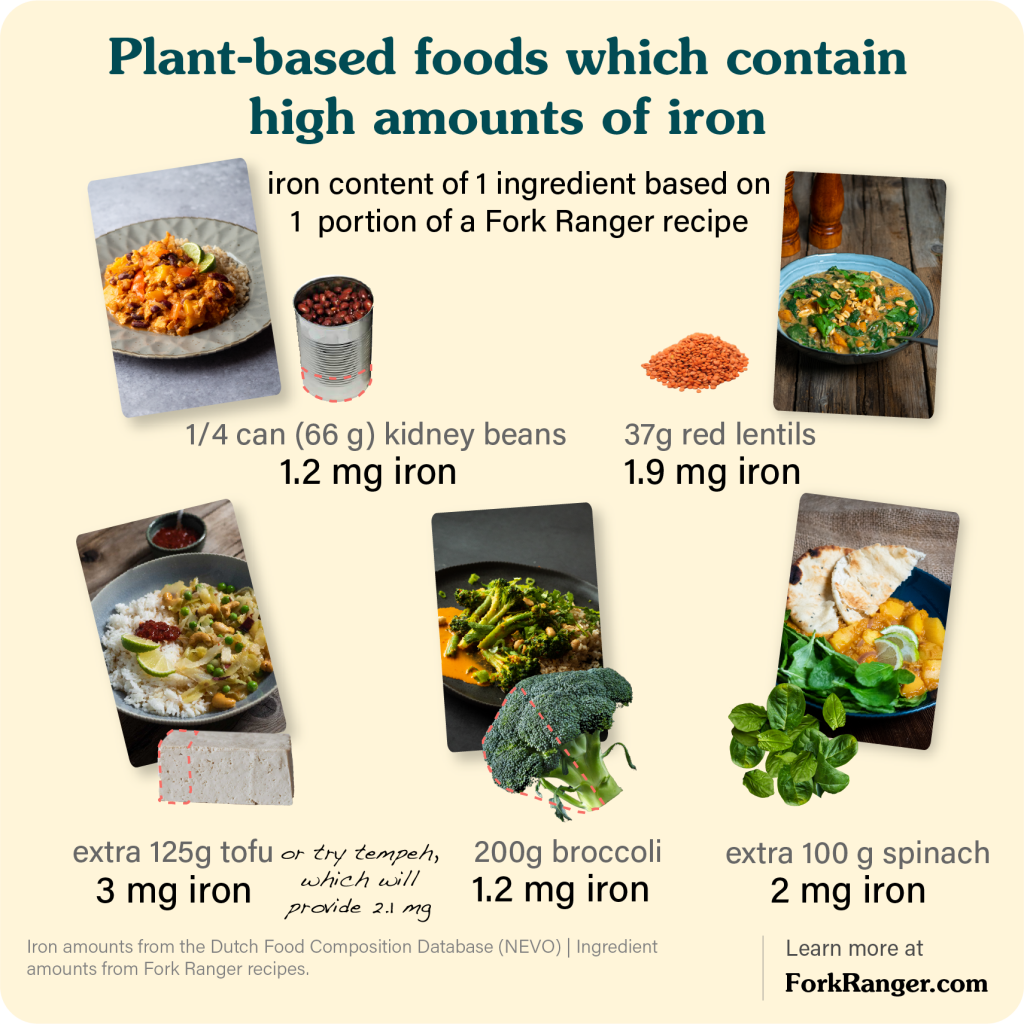
To make it more complicated: non-heme iron absorption itself can also be affected by other nutrients. So-called promotors, like for example vitamin C and other acids, increase absorption. Fun fact: plant-based diets happen to contain plenty of vitamin C, because people often eat lots of fruits and vegetables and these are excellent sources. But, there are also nutrients which decrease absorption, called inhibitors. For example, phytates in cereals and legumes and polyfenols in coffee and tea can decrease iron absorption. By the way, soaking or fermenting legumes also decreases the amount of phytates. For example, if you look at tofu and tempeh (both made from soy beans), tempeh will contain less phytates as it’s fermented.
But how much do these factors actually matter? Let me comfort you: this doesn’t mean that you should avoid eating legumes or drinking coffee. In a varied diet you’d get also enough promotors which could counter the effect of inhibitors. And this has also already been taken into account in setting the recommendations.
By the way, shifting to more iron from plant-based products also has an effect on your health. A high intake of heme iron (found in red meat and other animal products), is associated with a higher risk of developing type 2 diabetes and colon cancer.
So do vegans and vegetarians get enough iron?
Because of the complexities around iron absorption, it’s not sufficient to just look at the iron intake. Some studies have looked at:
- the iron status (the amount of iron in our blood)
- hemoglobin levels (the part of red blood cells which needs iron)
- the amount of people who had anemia caused by too little iron intake
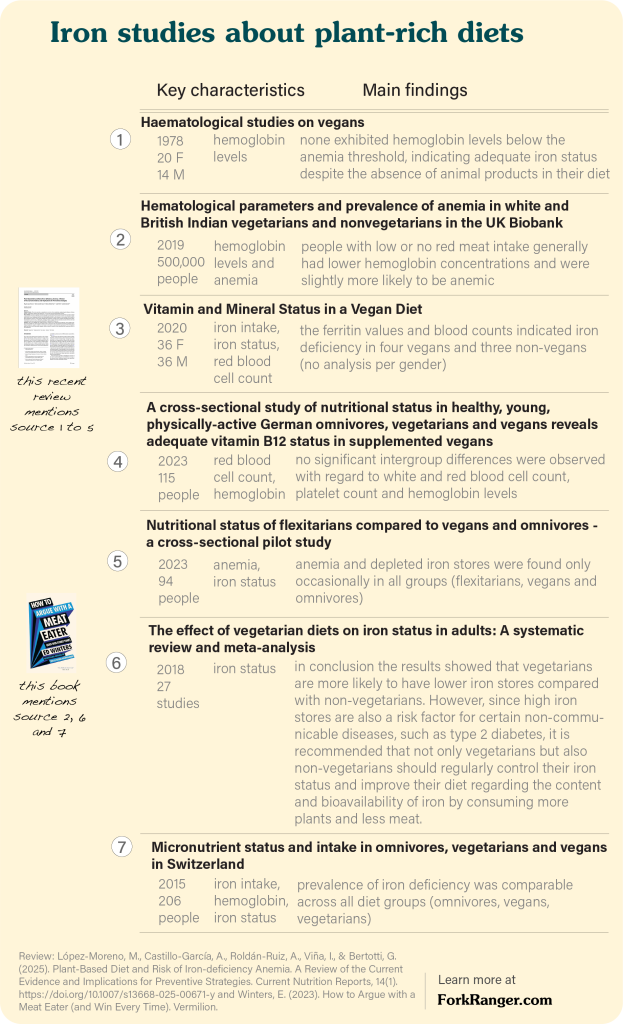
The studies then compared these factors for people with different diets. While it makes sense that the lower absorption of iron could contribute to an increased risk of anemia, there are sufficient studies that show no differences in terms of how often anemia occured among people following a vegan compared to an omnivorous diet. Some studies did show that the iron status of vegetarians and vegans is lower (but still on a sufficient level). We’ve summarized the research from the book How to argue with a Meat Eater and the sources mentioned in a recent review at the end of this blog, if you’d like to get into the nitty-gritty of the studies.
What is also interesting is that the absorption of iron is higher when you have a low iron status. To be more precise: when you have a low serum ferritin concentration in your blood. So while the iron status of vegetarians and vegans usually is lower, they are able to absorb non-heme iron much better than people with a high iron status. Pretty amazing right? That your body automatically absorbs more when the iron status becomes lower.
This complexity also translates to different dietary advice around the world. Some sources, the American department of Health and Human Services, recommend up to twice the amount of daily iron, if you eat less or no animal products to compensate for the expected lower absorption. However, the Dutch Voedingscentrum (and EFSA) does not recommend higher amounts for vegetarians, because the iron status despite being lower, is still sufficient.
Vegetarian or vegan, but how about EAT Lancet?
But now, let’s look at the Eat Lancet diet specifically, the diet we usually look at if we are talking about a sustainable diet. Recently, the new EAT Lancet 2.0 study was published. This study mentions that with the average EAT Lancet diet, women would only meet 79% of the required iron (and men 96%). Rather than a fixed assumption for bioavailability, they used a model to predict the iron absorption from complete diets. But despite a daily iron intake of 23.7mg, which is higher than the European recommendations, they still report that ‘the full nutrient adequacy might not be reached for iron’.
However, it is possible to optimise the average EAT Lancet diet in a way that the iron intake meets the required iron. EAT Lancet researchers did this by increasing the share of green leafy vegetables and adding algae. The first one doesn’t sound so difficult: but eating more algae?
Let’s zoom out, before we start worrying about eating algae. This study puts us in a tough place. On one hand side the EAT Lancet study concludes that the average diets don’t contain enough iron for women. But on the other hand, when we look at the references they used for the daily required iron intake, these references are much higher than the European recommendations. If we would compare them to the European recommendation, the EAT Lancet diet would contain enough iron, also for women. I’ve written a few questions to the research team to get into more details about this.
How do I know if I – personally – get enough iron?
Now that we’ve talked about so many scientific studies and recommended amounts, I was curious: what is my current intake? That’s why I created an overview of my typical day, as you can see below. It contains probably the majority of what I eat, as I might eat a little more dinner if I am hungry or eat an extra apple throughout the day. So most likely with those small extra’s I will get to the recommendation of 16mg. What’s interesting is that many ingredients which are recommended in a plant-rich diet as a protein source (whole grains, legumes and nuts) also provide plenty of iron. Whole grain products like bread don’t have the highest content if you look at the iron content per 100g, but because we eat quite a lot of them it adds up. On top of that it really surprised me that chocolate also contains iron! Finally, a good reason to eat a small piece of chocolate every day.
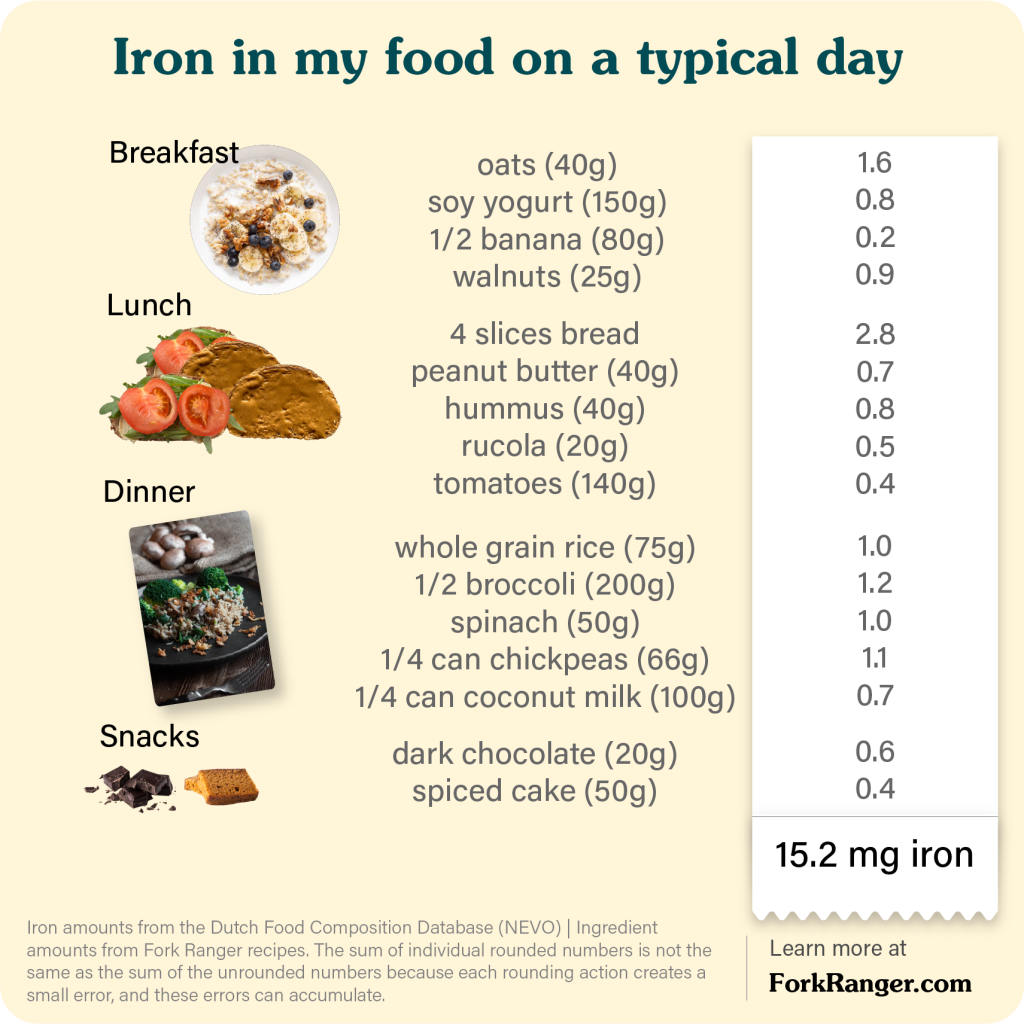
So to get an idea of your iron consumption, you can also keep a food diary just like I did. As iron is present in many different products, there’s no shortcut like for B12, where you only review animal products (and their fortified plant-based alternatives). You need to look at all the food you eat. Some spices, like curry powder even contain iron, so don’t forget them. If you’re curious you can keep a log (for example with this app – not sponsored) of everything you eat and check your own iron intake. However, this requires quite some work. Also it’s still an estimation, as the real iron content of foods depends on the soil the food is grown in. And even making a list cannot 100% guarantee sufficient iron, as there are foods that increase or decrease absorption and this effect is not included in this list.
The best way to know if your iron levels are okay is to get a blood sample checked (if you experience symptoms of iron deficiency like tiredness, restless legs and shortness of breath). I’ve talked with multiple nutritionists (among which Peter Res who reviewed this article) whether there are indicators that could help you understand whether it’s likely or unlikely that you have sufficient iron, and we always get back to this solution. I have to say, I wish it was different, especially because I don’t like needles.
A few more tips to get more iron from plant-based foods
If you found out you need to increase your iron intake – maybe through keeping a food log or by reviewing blood sample results, you’ve already seen that dark leafy greens, legumes and nuts contain iron. So adding more of those, is definitely a good idea. But there are also a few more tips I’d like to share with you.
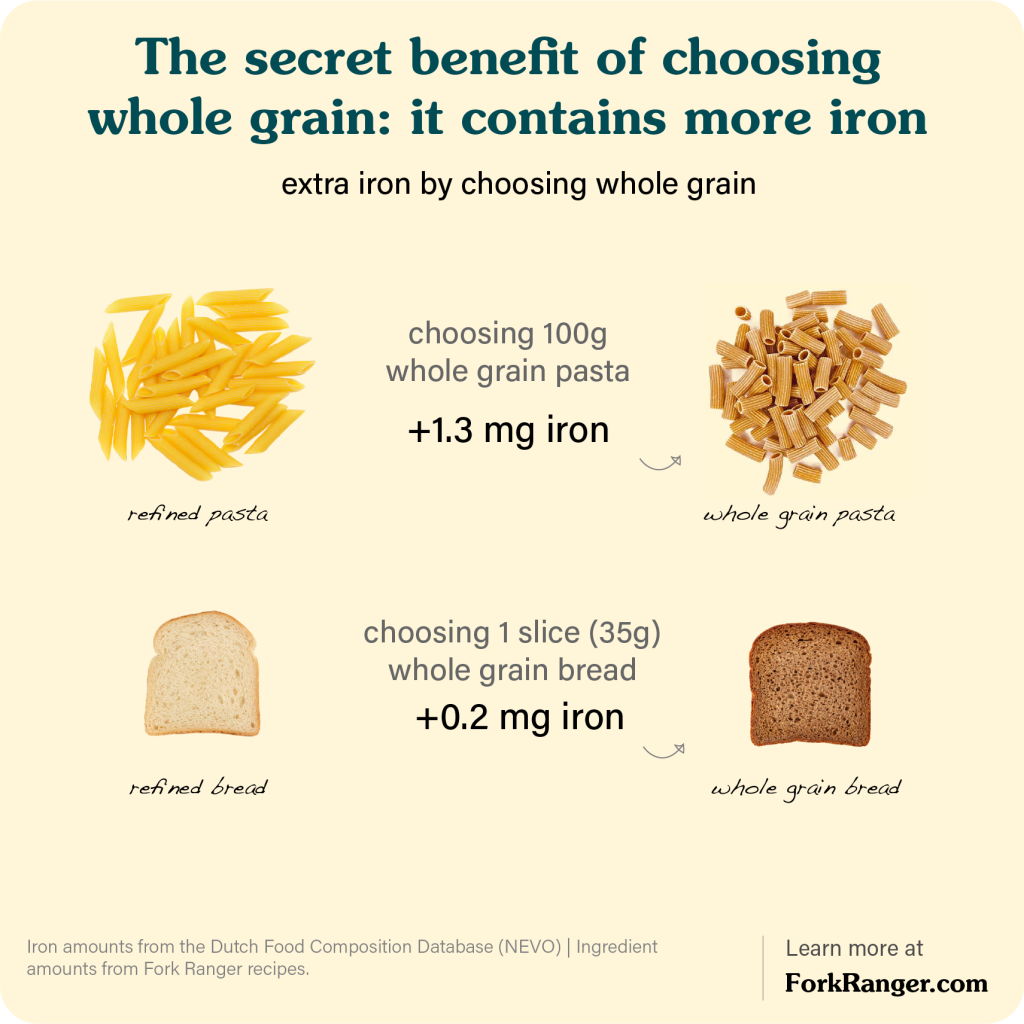
Whole grains also contain lots of iron, a lot more than their refined counterparts. So whenever you choose pasta or bread, just by choosing the right one, you automatically add more iron!
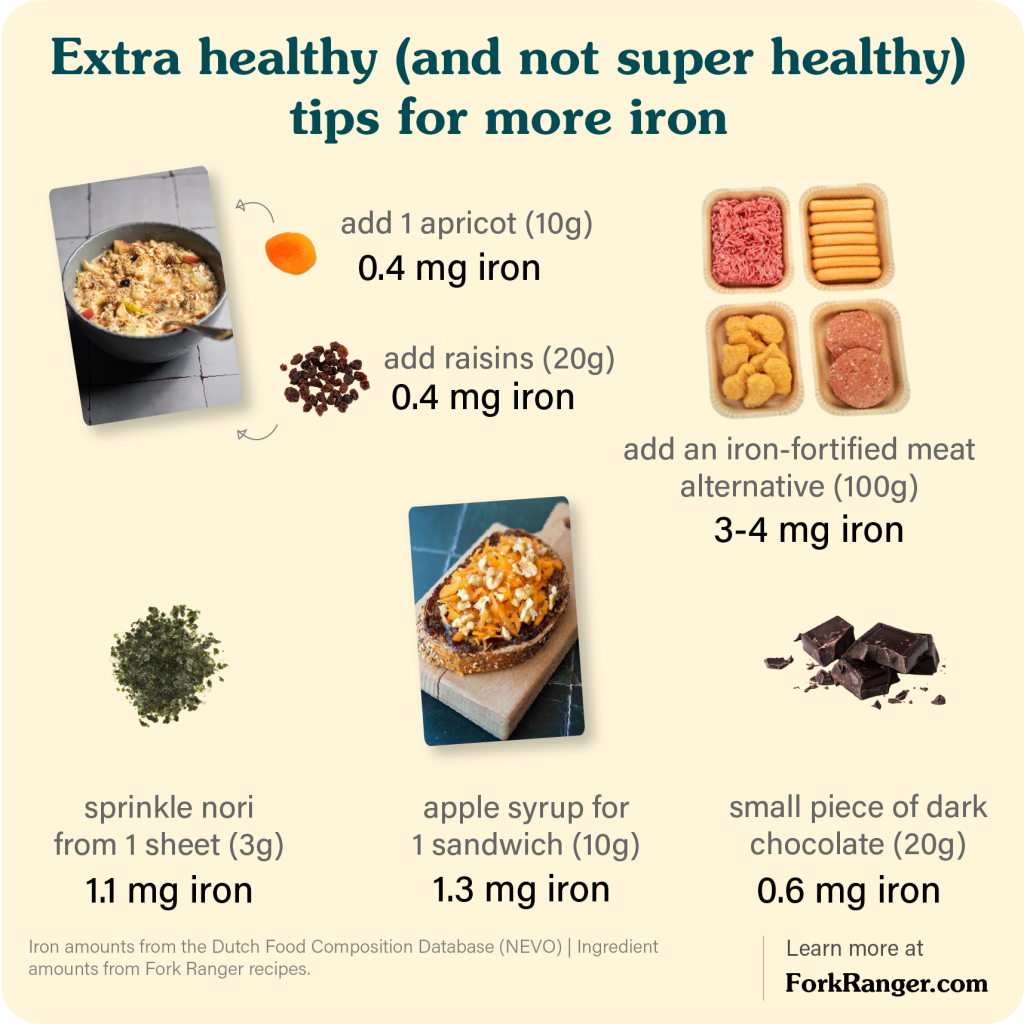
And then there a few more tips. You can add dried fruits like apricots or raisins to your breakfast! During lunch a sandwich with apple syrup can be a nice treat every now and then.
And what about dinner? Many plant-based meat or dairy alternatives are fortified with iron, to make sure they provide similar nutrients as their meat or dairy counterparts. In this blog (coming soon!) we’ve looked at how to select the right alternative looking at multiple aspects, but in terms of iron it’s best to select one with 0.8 mg/100 g or higher iron levels. The portion size is typically also 100g so this amount directly translates to how much iron you consume. I’ve seen alternatives with more than 3 or 4 mg or iron per 100g, so it’s an easy and healthy way to add more iron to your diet!
And there’s another dinner tip. While in Western cuisine this might not seem a mainstream ingredient, it’s a good idea to eat more ‘sea vegetables’. Not just because they contain quite some iron, but also because sea weed is a great climate solution. While nori is most known to be used for sushi, you can also just crumble some of the sheets over a meal as a topping. While one sheet typically only ways 3g it does contain 1.1 mg of iron. How impressive!
I left my personal favorite trick for last: dark chocolate! I love this one, although you shouldn’t eat too much chocolate obviously. That’s why I always choose dark chocolate because it’s easier to stop eating once I started. So my small piece of dark chocolate of 20g will give me an additional 0.6 mg of iron.
Conclusion
Out of the three nutrients that people often worry about – protein, B12 and iron – iron is definitely the most complex one! First, because it’s found in so many different foods (so you can’t just review a food group) and secondly, because its absorption is also influenced by different factors (which other things you eat or drink). And then on top of that, men and women need different amounts of iron and different institutions have different advice on the recommended amounts. So there’s certainly no ‘one size fits all’-approach.
When you move to a diet with more plants instead of meat and dairy, you will eat more non-heme iron (instead of heme iron), which generally has a lower absorption. But, when looking at studies that compared people who eat less meat with people who eat conventional amounts, sometimes differences where found, but very often also no difference were found. This might be because plant-rich diets contain more vitamin C which promotes iron absorption, or because your body absorbs more iron when the iron level in your blood is lower. The EAT Lancet diet that we often refer to as the sustainable diet to aim for, provides on average 23.7 mg iron per day. And so it depends on which recommended amounts you apply, whether this is sufficient or not. Unfortunately there’s no clearer conclusion to this.
Keeping a food log can be one way to get a better idea of your iron intake, but it won’t tell you anything about the absorbed amount. Therefore, we recommend to get a blood sample checked to be sure when you are experiencing any symptomps of anemia. If you do happen to be on the lower side and want to increase your iron intake, there are luckily plenty of ways to do that in a climate-friendly way. Simply, save the cheat sheets I’ve created for you and stick it in the inside of your kitchen cabinets.
Last but not least, after diving into this topic, I’ve added it to our development list to include information about the amount of iron to our recipes. And we’re keeping an eye out for the reply from the Eat Lancet commission.
Note: always consult your GP. This article is in no way giving you any medical recommendations or asking you to override your doctor’s advice. Fork Ranger is not responsible for any health issues you may have or develop in future.
Ik wil graag nog wat toevoegen. Ons hele lijf is zo ingesteld, dat als je ergens een te groot tekort van hebt, het lijf over het algemeen bij voldoende inname het ook meer opneemt. Puur tekort aan te vullen. Hetzelfde werkt ook andersom, als je ergens een te groot overschot van hebt, ga je bij verminderde inname dat ook sneller verliezen. Het meest herkenbaar zie je dat bij afvallen. Iemand die veel veel te zwaar is, valt de eerste weken veel sneller af dan iemand die maar een paar kilo kwijt hoeft.
Hallo!
Ik heb jarenlang veel groenten gegeten en weinig/ geen vlees en brood/ graanproducten. Langzamerhand heb ik daardoor een enorm ijzertekort opgelopen (bijna geen ijzer meer in het bloed).. Terwijl ik dus dacht gezond bezig te zijn. Sindsdien ben ik er in gaan verdiepen en het meeste uit je verhaal herken ik. Nieuw voor mij was het feit dat je lichaam meer ijzer kan opnemen bij een lagere waarde.
Ik miste echter in je verhaal dat koffie de ijzer opname remt. Ook zuivel kan de opname remmen dus liever niet in combinatie met ijzerrijke producten eten. Dat blijkt nog wel lastig te zijn.
Verder voeg ik dagelijks abrikozen en/ of grote dadels toe als tussendoortje. Het blijft zoeken naar een goede balans. Soms moet ik aanvullen met supplementen.
Mogelijk speelt leeftijd en leefstijl zoals veel of weinig sporten ook een rol.
Misschien kan je hier iets mee. Ik ben in elk geval blij dat jullie nu ijzer meenemen in de recepten.
Hi Heleen, dankjewel voor je reactie. IJzer is inderdaad een onderbelicht thema. Wat vervelend dat je een ijzertekort hebt opgelopen! Onder de eerste infographic noem ik de remmers, waaronder koffie. Ik heb bewust om het niet nog ingewikkelder te maken, de promotors en remmers kort genoemd, maar ben er niet uitgebreid op ingegaan (de blog werd anders te lang). En ook omdat het voedingscentrum zegt dat het effect daarvan is meegenomen in de aanbeveling van dagelijkse hoeveelheid. Wat betreft ijzer in onze recepten is dit dus NU nog niet meegenomen, maar zijn we van plan om dit inzichtelijk te maken!