How healthy is eating less meat and dairy: B12
This blog post has been reviewed by nutritionist Peter Res.
Main learning: whether or not you need to supplement B12 depends on the amount of animal products and B12 fortified alternatives you eat
Goal: check whether your B12 intake is sufficient
Impact: Medium 🌍🌍🌍⚪️⚪️ as part of paying attention to this when eating considerably less meat and dairy (see full Compass)
B12 is brought up often because many people know that B12 can be found in animal products. So what if you eat less of those? Will you still get enough B12?
Let me start by saying: it’s not weird that people are concerned, because even though we have a B12 small storage in our body, a long-term lack of B12 can lead to serious health issues. B12 plays a role in the creation of red blood cells and enables your nervous system to function well. Early detection and treatment of a B12 deficiency are important. If you have a deficiency for a long time, it can cause severe neurological problems and blood diseases. So yeah, no wonder people are worried.
The B12 tipping point
So, now back to our original question: do we still get enough B12 if we eat sustainably? At Fork Ranger we often refer to the Eat Lancet study when we recommend how a sustainable diet should look like. The amounts of animal products are lower than our current diet:
🥛 milk equivalents = 250g per day (1 glass of milk OR 2 slices of cheese per day)
🐄 beef, lamb, and pork = 14g per day (1 hamburger per week)
🐓 chicken and other poultry = 29g per day (1 chicken filet per week)
🥚 eggs = 13g per day (1-2 eggs per week)
🐟 fish = 28g per day (1-2 times fish per week)
So if you eat these sustainable amounts, do you still get enough B12? Eat Lancet has also included this question among their FAQs and write: “It would also increase essential micronutrient intake (such as iron, zinc, folate, and vitamin A, as well as calcium in low-income countries), except for vitamin B12 where the EAT-Lancet Commission points out that intakes may be inadequate and supplements or fortified foods may be needed (many foods are already fortified with multiple B-vitamins but not all with B-12).”
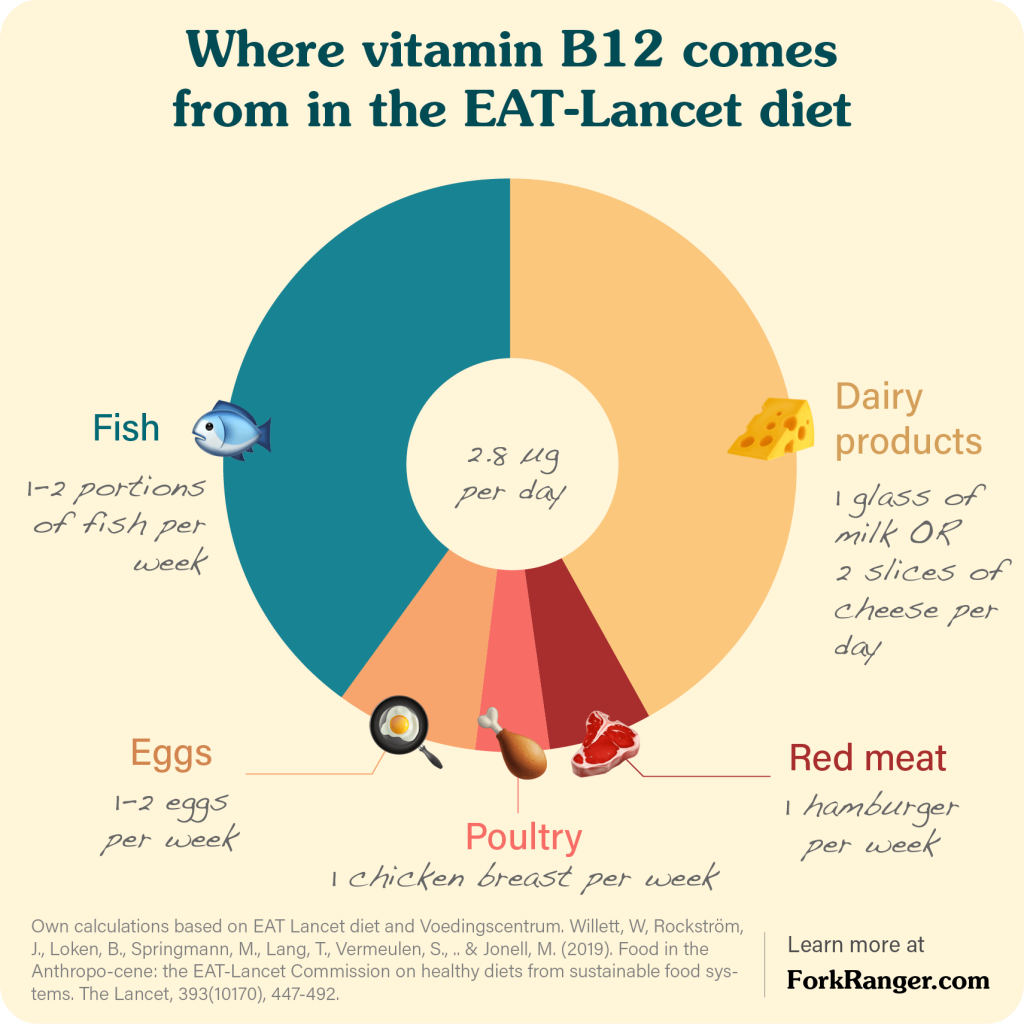
We wanted to know more, so we also calculated how much B12 is in all the EAT Lancet animal products on a daily basis. We found a total of 2.8 µg. This study did the same and found that it would get you to 2.24 µg, whereas the Gezondheidsraad recommends 2.8 µg for adults. Higher amounts are recommended for pregnant women and breastfeeding women. As the Eat Lancet diet might not provide sufficient B12, what should we do? Eat more animal products again, add B12-fortified foods, or add a supplement?
The climate impact of animal foods rich in B12
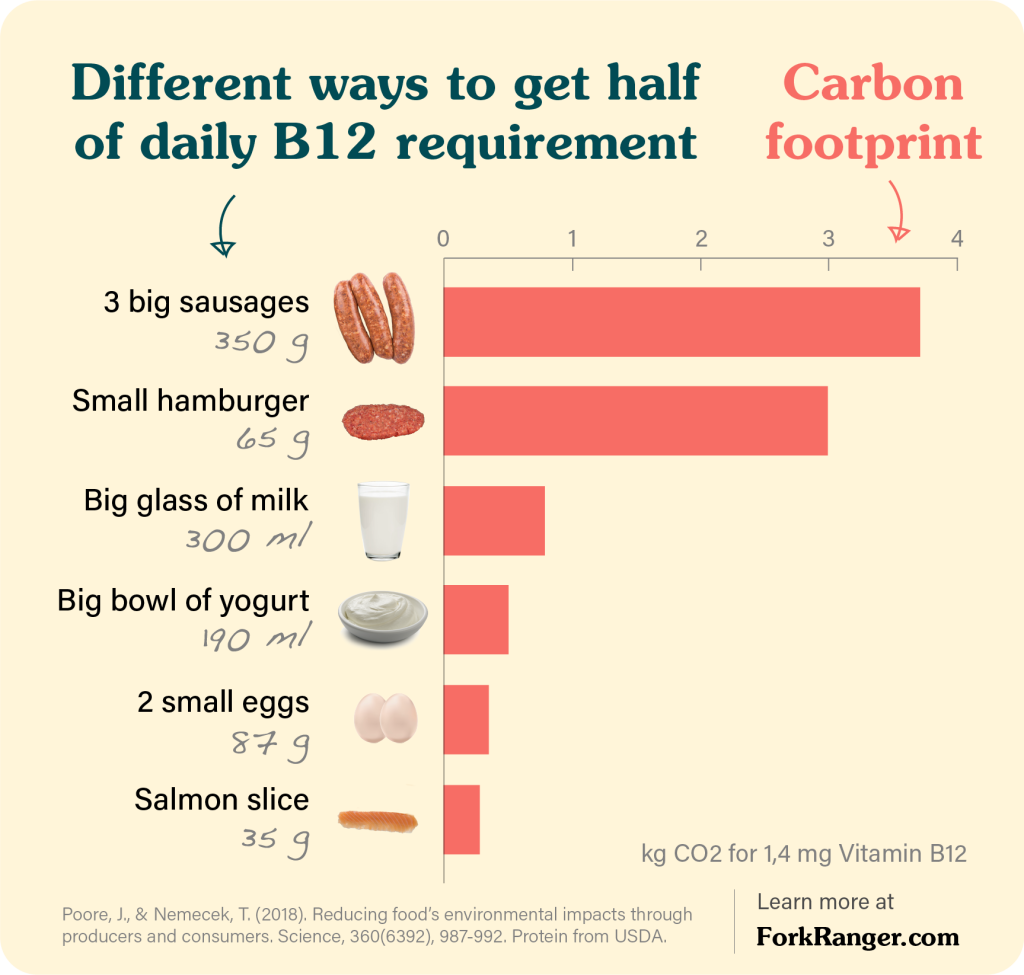
Let’s have a look at the sustainability of the products that contain B12. In our breakdown you can see that most of the B12 comes from dairy and fish. Salmon contains by far the most B12, and it also has a lower footprint than dairy and other meat, based on its B12 content. That makes it the most climate-friendly way to fill up your B12 levels. However, in general, smaller fish are more sustainable than bigger fish, and let’s not forget that there are other environmental issues around salmon farming. Read more about the sustainability of fish here.
Eggs and dairy also have a relatively high amount of B12 for a low footprint. Beef has even more B12 but also a much higher footprint. Pork contains very little B12.
Good to know: while it’s not shown in the infographic below, many plant-based meat and dairy alternatives also contain B12, as it’s added by the manufacturers.
How to get enough B12
While salmon contains relatively high amounts of B12 for its climate impact, it’s not really a sustainable solution to simply add more salmon to obtain sufficient B12. Let’s have a look at a few specific situations and how fortified B12 foods and supplements can help to get enough B12.
What if you stop eating meat
If you stop eating meat, but still eat low amounts of dairy, eggs, and fish, it is possible to make up the ‘missed’ B12 by eating dairy and meat replacements. To 100g of them often up to 15%-25% of the recommended daily intake of B12 is added. Do check the package of the product, because it isn’t the case for all products on the supermarket shelves.
When we do a small calculation, eating fortified replacements can supplement the dairy to still get to your recommended intake.
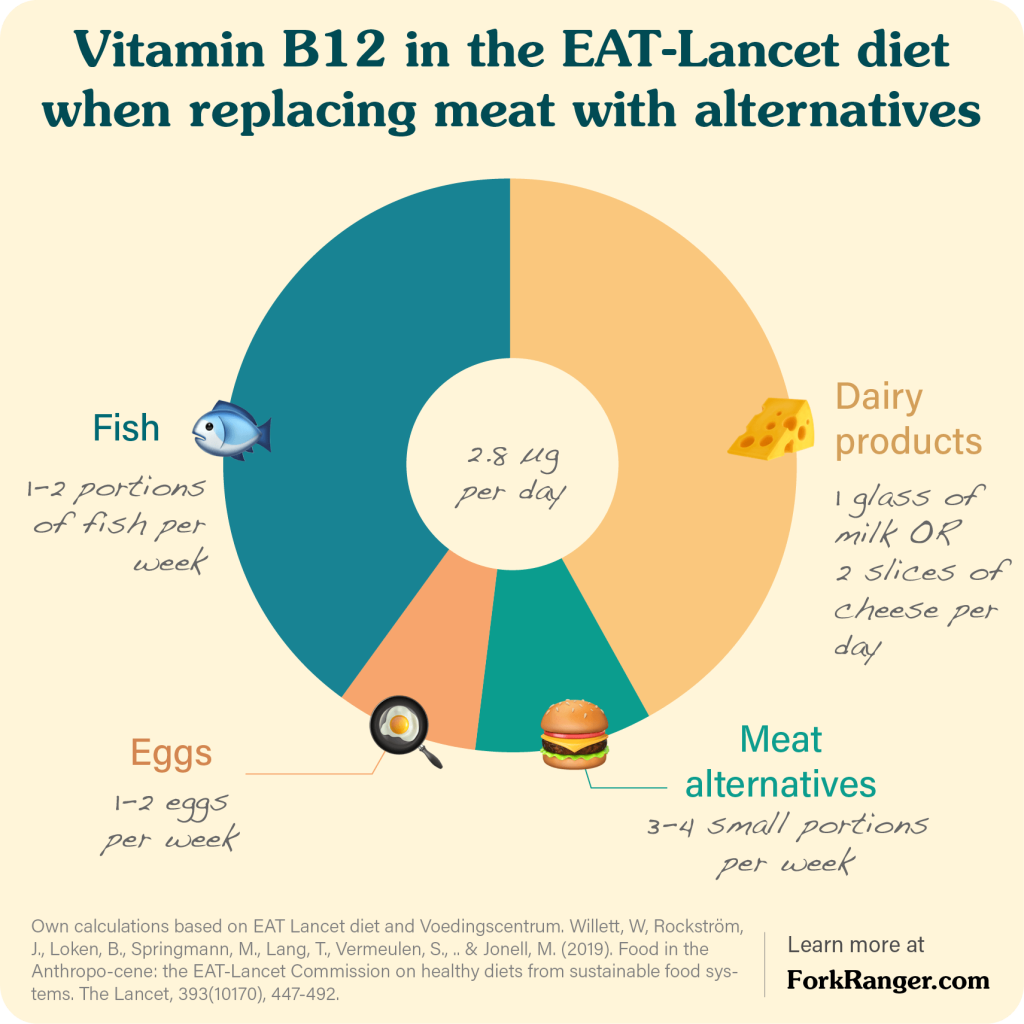
When you leave the fish away, your B12 intake would drop below the recommended amount, so you’d have to eat more dairy and meat replacements or take a B12 supplement.
What if you stop eating all animal products
So if you stop eating meat, fish, AND stop eating dairy, it will be hard getting enough B12 by eating meat and dairy replacements. You would have to eat as a single person 1,5 containers (750g) of fortified soy yoghurt OR 1-2 packages (350g) of meat replacements OR half a package of margarine (100g) EACH day. Probably there aren’t many people who would do so ;). Therefore, if you stop eating all animal products, it’s a better idea to pick a B12 supplement.
That brings us to the practical question: which B12 supplement should I pick? The Dutch Vegan society has a very informative blog (Dutch only!) about the things you should consider when taking a B12 supplement.
If you want to make sure your B12 levels are sufficient, consult your GP and make sure you get a blood test. And don’t forget to stop taking the supplement a week before the test, so it doesn’t affect the results.
And last but not least, what should you say to all the people who say ‘you see, that’s why veganism is not natural, because you can’t survive without those supplements?’.
B12 is only formed by bacteria which live in soil, water, in our own colon, in the rumen of cows and other animals. So even animals do not make b12 themselves, but have to rely on bacteria to make it for them. But even cows cannot rely on natural intake anymore. The bacteria that form B12 also need the mineral cobalt for this. But because their feed usually doesn’t contain enough cobalt naturally, the bacteria in their rumen that form B12 cannot form B12 anymore. That’s why nowadays their feed is supplemented with extra cobalt or even B12. So, I guess both are not really natural anymore…. so what is against skipping the animal and having bacteria make it for us directly for a supplement?
There’s one more group that needs to pay more attention
If you are over 60, you need to pay more attention. This is because your body absorbs B12 from food by coupling it to a so-called intrinsic factor. And because this intrinsic factor is produced less when you get older, you could have a B12 deficiency even though your intake is sufficient.
A 1999 study estimated that 10%-15% of people over the age of 60 are affected by B12 deficiency. Also the NHS, the UK healthcare system, mentions that both B12 deficiency and folate deficiency are affecting around 1 in 10 people aged 75 or over and 1 in 20 people aged 65 to 74.
Conclusion
While hardly anyone has to be concerned about protein, it can be a bit more difficult to asses if you get enough B12. Because it’s found only in animal products (and alternatives for animal products), it’s still easier to keep track of than iron which is found in all food products.
But still, most of us don’t need to worry about B12, especially flexitarians. Only once you get close to eating the amount of animal products as specified in the Eat Lancet recommended diet (or less), you will have to start thinking about adding plant-based foods fortified with B12 or about taking B12 supplements. The Eat Lancet recommended diet gives you around 2.3 µg-2.8 µg daily compared to the recommended amount of 2.8 µg for adults, so it’s quite likely it won’t be sufficient.
Only once you fully stop eating meat you should be aware that you need to add extra B12 to your diet. The easiest way is by eating meat and dairy alternatives, but you might prefer taking a B12 supplement instead. Also, for people who don’t eat meat and dairy at all, the latter is definitely advised, as you simply can’t eat the amount of meat and dairy alternatives to get enough B12 (unless you’d like to eat 1,5 containers of fortified soy yoghurt each day).
Practical tips
- Don’t worry if you still sometimes eat meat and dairy: you will get sufficient B12
- If you want to increase your B12 intake by fortified meat and dairy alternatives, check the packaging for the amounts (don’t forget to take into account the serving size), it varies quite a bit per brand.
- And if you opt for B12 supplements, there are tons of different options, so inform yourself.
Note: always consult your GP. This article is in no way giving you any medical recommendations or asking you to override your doctor’s advice. Fork Ranger is not responsible for any health issues you may have or develop in future.