South of the Netherlands micro food adventure 🥾
This micro food adventure is part of a series of microadventures to discover sustainable food pioneers. Read more about our the impact of local food and don’t forget to let us know how you experienced this route (mareike@forkranger.com).
Link to the route – 15 km
Tip: if you use komoot app without the navigation function, it’s free!
This micro food adventure starts at Etten-Leur station and you finish the hike 🥾 at busstop Krabbebossen in Rijsbergen from where you can easily get back to Breda 🚎.
First stop: De Santspuy
From Etten-Leur you make your way to the first stop asparagus and wine farm De Santspuy, where you arrive after 5,6 km. Follow the signs that lead from Zandspui to the farm.
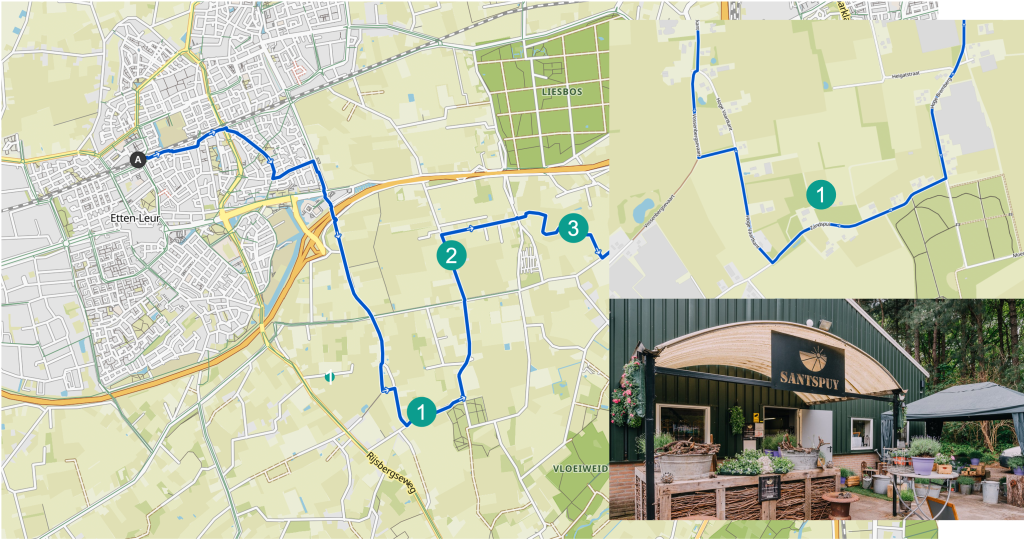
Why we picked this stop for you → First, because asparagus is Mareike’s favorite vegetables. But also because we wanted to see what we can learn from asparagus. Have a look around this place. It looks fancy, right? Maybe because of the wines, but no doubt also because of the fact that they grow asparagus. How many vegetables have the fancy reputation that asparagus have? Would you have been as excited if I would’ve told we would stop at a carrot farm? Asparagus has this reputation because 1) it’s expensive and 2) it’s only available in season – even in supermarkets you can’t get fresh asparagus year-round. And did you also notice that dishes are often described as ‘Asparagus with…’. Now you know who got the lead role ;). So what if we take asparagus as an example for how we can eat sustainably: give vegetables the lead role on our plate. And maybe if we buy them local, they instantly rise in value because we made an effort to obtain them. They’re not just anonymous carrots anymore, we know from which farm these carrots come and who grew them for us.
Second stop: Ekoto
It’s only a little further to our next stop Ekoto, basically down the road (at 7,7 km from the start).
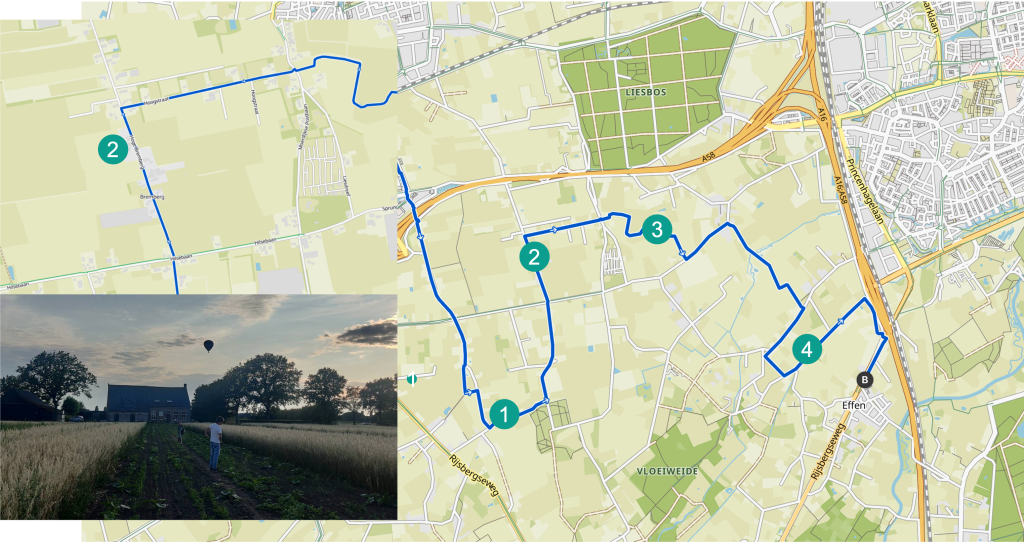
Why we picked this stop for you → We met Ivar at the beginning of our Fork Ranger journey and have been supporting each other ever since. This is probably because we both have a curiosity to try out new concepts. When Ivar came with the idea of actively farming all the land again, but then organically and with some kind of (in his own words) “weird” strip-cropping system, his family was slightly skeptical. Nonetheless he pursued and a true diverse landscaping project with such diversity started to bloom. Gradually the fellow family members got excited and they started bringing even more of a diversity to the farm with many new vegetables but also all kind of farm animals. Now the farm, that went dormant after two generations of farming, has gotten back to life! And with all this diversity, the farm gets this traditional feel that many farmers secretly still long for.
Did you spot the strip-cropping system? (this can be hard to see depending on the season you visit) In industrial agriculture big fields are filled with just one crop, essentially taking out biodiversity. At Ekoto Ivar tries to combine the benefits of traditional farming together with moderate efficiency. The strip-cropping method is such a model that is being tested. Every few metres another crop can be found, enhancing biodiversity and taking out the need for external inputs as pesticides. But by keeping the strips narrow but long, a lot of work can still be done mechanically and thus moderately efficient. Quite smart, don’t you think?
Third stop: Herenboeren Breda
Once you come to the end of the Hoogstraat and start walking on the hiking path (after 8,7 km), everything on your right side is from Herenboeren Breda. If you just follow the hiking path, you will see a large part of the farm. Please don’t venture out over the farm yourself (the farm is private property), simply stick to viewing it from the hiking path.
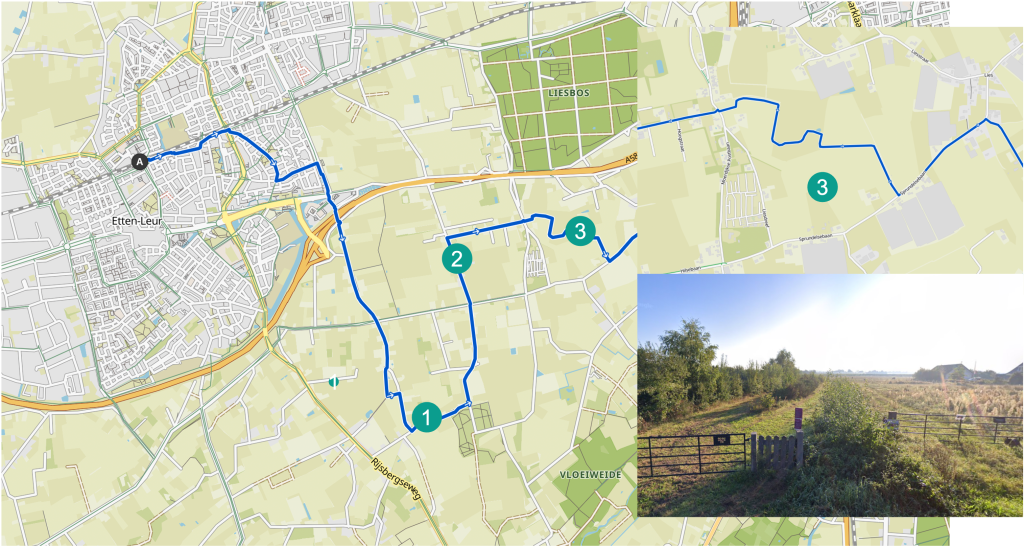
Why we picked this stop for you → This is one of the 22 Herenboeren farms in the Netherlands. This is community supported agriculture, but then with even with more commitment than just a share of the harvest. The unique thing about a Herenboeren farm is: you own 1/250th of the farm. Together with 250 other households a farmer – here in Breda it’s Sven – is hired full-time to bring work and agricultural knowledge. This commitment enables also a stable economic foundation.
Not only did we include this stop for you because we want to showcase a Herenboeren farm, it’s also an excellent way to understand land use of animal products compared to plant-based products. From the 20 hectare farm, roughly 5 hectares is used for vegetables, grain and legumes production and the remaining 15 hectares is mostly for meat production (and plenty of fruits and nuts from the hundreds of trees in the pasture). The vegetable production is sufficient to serve the 250 households with enough vegetables for roughly 5 meals throughout April til December, and half of it during the wintertime. For the meat production have cows and pigs. While the cows are pasture-fed the pigs and chickens (for eggs, not meat) are fed some extra feed (so that will require land you cannot see). People who choose the meat package will receive 6 times a meat package which is a total of 15-20kg a year, or 280-380g of meat a week. This is actually quite similar to the amount of meat we need to get to for a sustainable diet. So you can really see the dimensions here: for this relatively low amount of meat we need a lot more land than for the vegetables. Is it now easier to imagine how much land is needed on a global scale if we eat much more meat than these low amounts?
Did this farm make you excited to be part of it? Every month there’s a guided tour and an information evening. And after that you can even try it out for 4 weeks. More info on their website.
Fourth stop: Moervliet
Once you leave the hiking path and continue on the Sprundelsebaan, you’ll discover a piece of art ‘Landbouw in de toekomst’ by Kimberley Rochat. What feelings does this futuristic image stir in you? Do you believe that through technology and innovation we will grow food despite climate change? Or do you think we should go ‘back’ to natural and organic farming and work with nature? Often these are seen as one or the other, but maybe we can become more like Ivar and take the best of both… The same goes for local food, we can’t feed the world with 100% local food, but that doesn’t mean that all local food is useless.
We make our way to the next stop: Moervliet farm, which you will reach after 13 km.
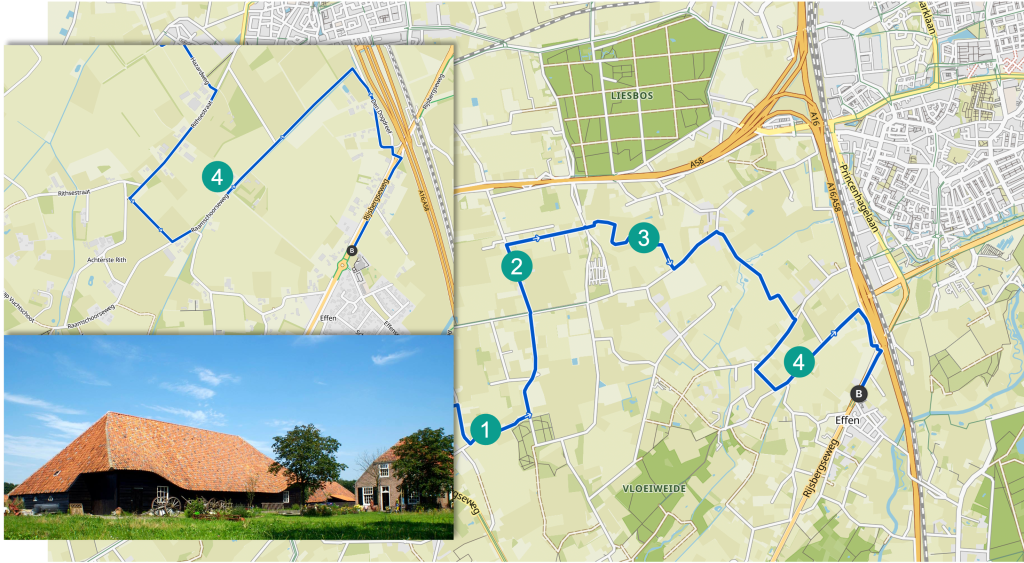
Why we picked this stop for you → At Fork Ranger we often talk about the importance of increasing organic food production. This farm practices a special form of growing food organically: biodynamic agriculture. The difference is not something that might be directly visible from the outside, but lies in a different approach that goes beyond the organic practices. Actually, biodynamic agriculture was the first form of organic agriculture when philosopher Steiner proposed it in 1924. Rather than different farming practices, it originates from a different vision of life. This is also reflected in the 5 core values of Demeter (the international biodynamic certification):
- Caring for a living soil
- Respecting the integrity of the animal
- Caring for life forces
- Viewing the company in context and the care of the business organization
- As a human being wanting to develop in agriculture
This might sound a bit up in the air, but keep in mind that this thinking came from the one who stood up against industrial farming and was the founder of an alternative from which the whole organic movement stems. Or wait, wasn’t organic the standard before we started applying synthetic fertilizers and pesticides?
Let’s look into one concrete example of biodynamic agriculture to understand the approach better. Let’s look at bee-keeping. Farm De Moervliet keeps bees not for their honey, but for an increased biodiversity at the farm. The bee colony is seen as one organism. This includes the queen, the workers, the drones, the combs, the brood, the supplies of pollen and honey, but also the entire environment that the bee takes care of. And this can be up to 60 km2. The farmer then feels responsible to make sure there’s enough food for the bees. It’s interesting how this viewpoint leads to a deep connection between the animals and the landscape. While you still might think this is a bit spiritual to you – especially for us Dutchies – imagine how the world could look if we felt more connected with the world around us. Eating local food and being connected with the land that feeds us can bring back this connection we sometimes lost. Curious about more of the beekeeping approach: read more here.
Wow, this can be a lot to take in. Walking the remaining 2 km is a good way to wrap your mind around it: just a small part to go where you can take the bus from busstop Krabbebossen to Breda.
Extra info (updated April 2025):
- Sandspuy‘s farm shop is open depending on the season. In April, May and June (asparagus season), they are open Monday-Saturday 9:00-18:00 and Sunday 11:00-18:00. Later in the year in July, August and September, they are open on Saturday 10:30-18:00.
- Ekoto‘s farm shop is open Saturday 9:00-12:00 from late spring til the end of fall. They also have crafts markets seasonally!
- Herenboeren Breda is not open, but have a guided tour every month.
- Boerderij de Moervliet‘s farm shop is open Monday-Saturday 10:00-18:00 and sells potatoes and seasonal vegetables.