Fork Ranger x Universidad de Alicante
Fork Ranger x Universidad de Alicante
Food is the area of consumption with the largest carbon footprint on the planet, as its contribution to greenhouse gas emissions is estimated to be close to 33%. For this reason, it also has the greatest potential for mitigation and adaptation to the current global social and environmental polycrisis.
Furthermore, food is closely linked to the culture of society, so educational action in society can have multiplier effects not only on the people who receive and participate in the educational action, but also on their closest circle of friends and family, and on future generations.
The necessary transformations that we can develop through education include committing to local food systems and short marketing channels that prioritize direct connections between producers and consumers, understanding the impact of the food value chain on society and globalplanetary health, knowing and understanding the carbon footprint of food and the food industry, committing to a planetary diet that introduces fresh, healthy foods with a low carbon footprint, reducing energy consumption in our kitchens when preparing meals, and drastically reducing food waste in our homes. As this is the main field of action for mitigation, it is crucial to
create a dissemination project that prioritizes simple communication and promotes meaningful learning, using tools such as gamification, sensory and interactive activities, and a playful learning environment, in which participating students learn by playing and interacting with the media at their disposal. For this reason, this outreach project proposes an interactive
exhibition on the food value chain that includes an escape room as a reinforcement and evaluation activity for the proposed content. The exhibition will be divided into five separate sections. Specific decorative elements will be used in each section, along with explanatory panels and Playmobil figures to illustrate the scenes for younger audiences.
The first section will focus on the production phase. Highly visual infographics from Fork Ranger will be used to explain complex processes such as changes in land use, the impact of intensive monoculture on biodiversity loss, the social, environmental, and economic impact of global markets, the world bread baskets, and the impact of climate change on certain crops.
The second section will cover the transportation, storage, and processing of food products. The third section will focus on the role of commercial distribution in the consumption of food products, represented by elements of a food store that contain easy-to-understand anecdotal data and statistical information.
The fourth section will be two kitchens representing a restaurant kitchen and a home kitchen to illustrate how we prepare, store, cook, and taste food products. The fifth section will deal with post-consumption and food waste generation at home.
An online version of the exhibition and escape room will also be created to give it greater visibility.
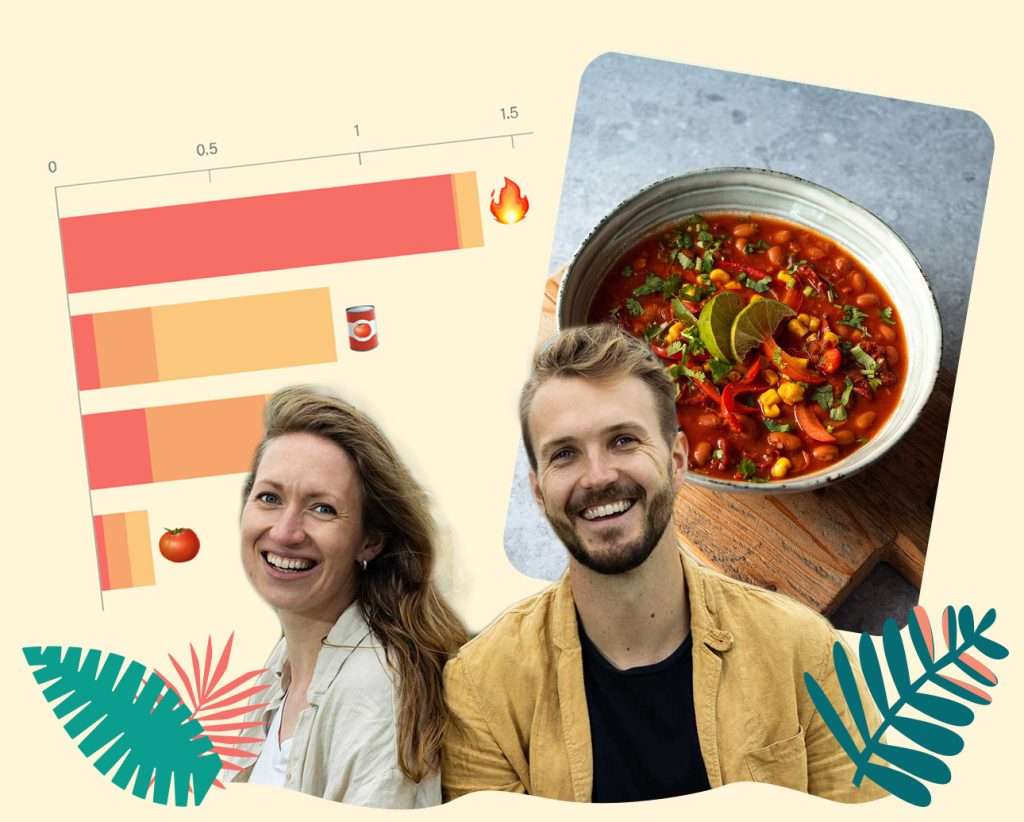
Professors Alba Martínez García and Ana Espinosa Seguí are collaborating with Fork Ranger (https://fr-wp.cowdev.com), a Dutch project promoting sustainable food, on the translation of the mobile app into Spanish. The Fork Ranger’s infographics visualize the main challenges and problems of sustainable and healthy eating in a very graphic, simple, and understandable way for students of all educational levels.These infographics were used in the show cooking event “Cooking for the planet: how to reduce our emissions and avoid food waste” that the two teachers held in October this year: https://www.youtube.com/watch?v=9TWWdx4Vgf4&t=175s and which perfectly exemplifies how the information will be presented in
the exhibition.
Each section of the exhibition will be associated with a test that will form part of an escape room focused on consolidating the knowledge explained. The ultimate goal of the exhibition and its associated gamification activity is to raise awareness, through the design and implementation of the exhibition and the escape room, and to scientifically evaluate the effectiveness of transmitting this knowledge to promote changes in individual behavior, social norms, and food systems from various turning points.
This outreach project works primarily with two key sustainable development goals: goal 4 on quality education and goal 12 on “Responsible Consumption and Production,” but the project’s objectives are directly linked to goal 3 on good health and well-being, goal 6 on clean water and sanitation, goal 7 on affordable and clean energy, goal10 on reducing inequalities, goal 11 on sustainable cities and
communities, and goal 13 sanitation, 7 on affordable and clean energy, 10 on reducing inequalities, 11 on sustainable cities and communities, 13 on climate action, and 14 and 15 on life below water and on land ecosystems, respectively. Priority will be given to the use of recycled, second-hand, or
refurbished materials to reduce the carbon footprint of the entire exhibition, and companies such as Ikea and Playmobil will be asked to collaborate on the project by providing decorative elements and toy figurines that will better illustrate the processes explained.